
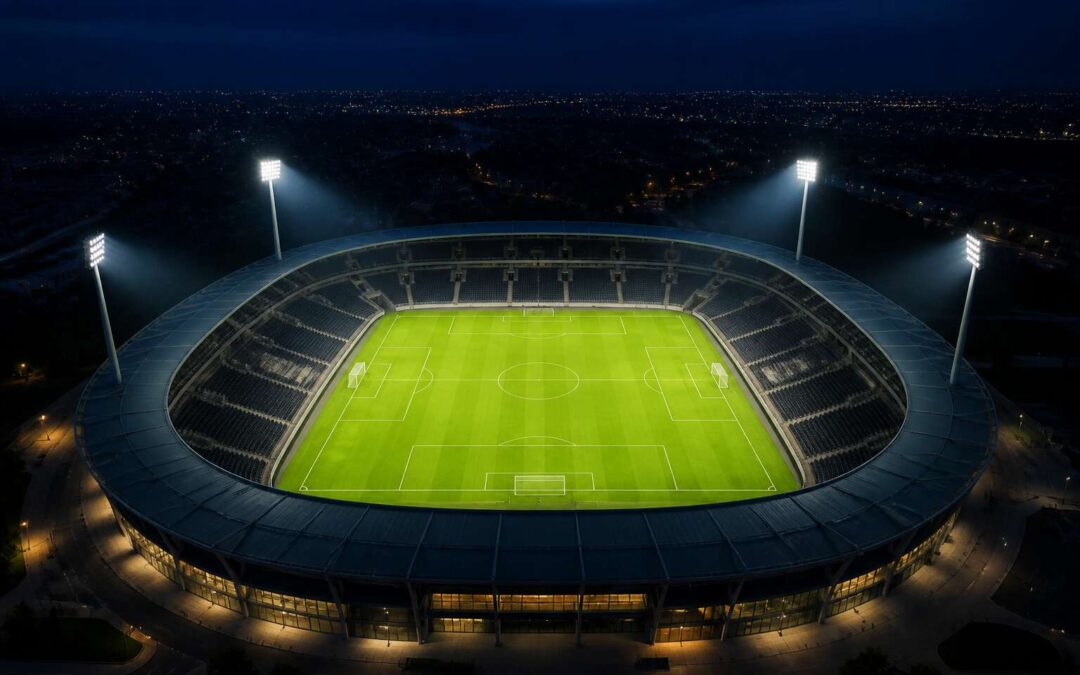
Understanding Stadium Floodlighting
Key Features of High-Performance Floodlights
A single evening match can draw tens of thousands of spectators. Every one of them expects perfect visibility from the stands. High-performance flood lights for stadium need precise beam control, true colour rendering, and durability against harsh weather.
Modern systems use asymmetric optics to direct light exactly where players move. This reduces glare for spectators and minimises light spill into surrounding suburbs. Thermal management prevents overheating in our hot climate, extending the lifespan of every fixture.
Key features to evaluate:
– Luminous efficacy measured in lumens per watt
– IP rating for dust and water resistance
– Surge protection against lightning strikes
– Uniformity ratio across the playing surface
Each element affects performance and running costs.
Importance of Uniform Illumination on the Field
One dark patch on the pitch can alter a result. For a player sprinting at full speed, uneven light hurts depth perception. A cricketer loses sight of the ball. A forward mistimes a header. Spectators see the action flicker into shadow.
Uniform illumination serves fairness. It ensures a goalkeeper sees the trajectory of a shot. It lets a batsman follow the ball from bowler to bat. Every angle in the stands shows the same, true picture.
Poor coverage creates measurable problems:
- Balls appear to change pace
- Officials hesitate on edge decisions
- Players slow down near dark zones
Reliable flood lights for stadium eliminate these faults. They keep the field consistent for the entire match.
Lighting Standards and Regulatory Compliance
A stadium floodlighting project fails long before kickoff when it ignores the rules. Standards are not paperwork. They determine whether a venue can host an international match, protect players from disabling glare, and respect surrounding residents.
In South Africa, engineers work with SANS 10381 for sports lighting and align with IEC 60598 for luminaire safety. Broadcasters add their own demands. The ICC, FIFA, and World Rugby publish strict limits for uniformity, glare rating, and vertical illuminance. Each one changes how flood lights for stadium are aimed, mounted, and controlled.
Compliance review for flood lights for stadium covers more than lux levels. It verifies:
- Luminaire thermal limits and electrical isolation
- Emergency lighting and failover switching
- Glare and spill light at the venue boundary
- Testing records for flicker and driver compatibility
Local municipalities may add bylaws on night-time light spill. Meeting these standards separates a host venue from a years-long legal battle.
Assessing Lux Levels for Different Sports
At Ellis Park, a night match demands 750 lux across the playing field. It doubles when the broadcast cameras arrive! For flood lights for stadium, understanding these numbers is the difference between a clear sightline and a dangerous guess.
Each sport demands a different pattern of illumination. A tennis serve requires a vertical illuminance that lets a player see the ball’s arc. A football striker needs even horizontal coverage to judge a through ball. What works for a provincial cricket match will fail a FIFA presidential inspection.
- Community football: 100 to 200 lux
- Local league cricket: 250 to 400 lux
- International rugby with television: 750 to 1400 lux
Assessing lux levels starts with the sport, then the competition tier, then the athletic movement. Flood lights for stadium that serve one discipline may blind another. Engineers in Pretoria and Cape Town measure these values before a single pole is erected.
Types of Floodlights for Sports Venues
LED vs. Traditional Metal Halide Technologies
The choice between LED and metal halide is a decision about the venue’s future. Metal halide fixtures have served stadiums for decades, but they demand warm up periods and constant relamping. LED arrays switch on instantly and endure the harsh South African climate without flicker.
Consider the maintenance reality:
– Metal halide lamps lose up to 40% of their output before failure
– LED modules hold consistent lumen output for 50,000 hours or more
For any facility manager weighing flood lights for stadium projects, the long term cost of ownership favours LED. The upfront expense of LED flood lights for stadium installations still gives buyers pause. Yet the energy savings and reduced labour justify the investment. When night falls and the towers ignite without hesitation, the contrast becomes obvious: the old light warms up slowly, the new light simply is there.
Choosing the Right Wattage and Lumen Output
Stadium floodlights consume 80 percent of a venue’s energy bill. Choosing a beam pattern matters. Types of floodlights for sports venues include asymmetric, which directs light downward and forward, and symmetric, which spreads it evenly. Asymmetric suits football and rugby pitches where glare bothers players. Symmetric works for multipurpose courts. Wattage is the standard specification, but lumen output reveals actual brightness. A 1200 watt LED unit may produce 180,000 lumens, while a 2000 watt metal halide generates far less after a season. For flood lights for stadium towers, measure usable lux at field level, not raw lamp power.
Compare these factors when selecting units:
- Beam angle and corner coverage.
- Surge protection for South African storms.
- Lumen maintenance after 10,000 hours.
Lumen output drops as drivers heat up, so demand thermal ratings. A higher wattage does not guarantee a safer night game. Efficiency does!
Beam Angles and Optical Control
Beam angles decide whether a floodlight performs or just glows. A narrow 15 degree beam works on tall masts but leaves corner flags in darkness. Wide 60 degree optics spread light, yet poorly aimed units spill brightness into nearby streets. Optical control uses baffles and precision lenses to keep every ray on the pitch.
For flood lights for stadium, match the beam shape to the sport. Rugby needs an elongated footprint; tennis courts want a square distribution. Interchangeable lenses let you adjust without replacing the whole fixture.
- Verify the beam angle at 50 percent intensity, not the edge.
- Choose asymmetric reflectors that reduce upward glare.
- Check the shielding angle for spectator comfort.
Glare is the silent opponent. A poorly controlled beam bounces off surfaces and creates dark patches. Good optics keep light off the goalkeeper’s face.
Smart Lighting Controls and Dimming Capabilities
Different venues demand different tools! Flood lights for stadium in South Africa now come in specialized forms, each suited to a specific task:
- Asymmetric optics for pitch boundaries and touchlines
- Symmetric reflectors for training grounds and open fields
- Hybrid units that adjust between wide and narrow beams
The housing matters as much as the chip inside it. Die-cast aluminium bodies with powder coating handle the Highveld sun and coastal salt without corrosion.
Smart lighting controls push these systems further. A central processor can dim individual poles to match training sessions, broadcast lighting, or halftime shows. DALI or 0-10V protocols allow real-time adjustments. Motion sensors in storage areas reduce energy waste. For night matches, preset scenes change colour temperature and brightness. Dimming capabilities also protect the equipment, and that matters for any flood lights for stadium. Gradual ramp-up reduces thermal stress on LEDs, extending their lifespan.
Design and Installation Considerations
Lighting Tower Placement and Height
Placement and height of light towers quietly govern the entire match experience. A tower positioned too low leaves pools of shadow on the wings, while one set too high turns athletes into mere silhouettes. For stadiums in South Africa, the planning begins with the stands’ geometry and the local weather patterns. The critical decisions can be summarised in three points:
- Tower feet must clear the outer concourse and emergency access lanes.
- The aiming angle should keep spill light below the roofline of adjacent structures.
- Service platforms need safe crane lift zones, especially for flood lights for stadium replacements.
The preferred mast height generally spans 28 to 42 metres. That range balances beam control with vertical illuminance. Anything shorter demands a broader beam, which often wastes energy. Anything taller reduces the contrast on the ball at high speed. Ultimately, the numbers come from the lux levels required by the sport, combined with each tower’s setback from the pitch.
Electrical Infrastructure and Power Supply
The electrical infrastructure behind a major sports venue is a discipline of precision. A sudden dip in voltage during a penalty shootout can dim a crisp white beam to a sickly amber. In South Africa, where municipal supply sometimes wavers, the power design matters as much as the luminaires themselves.
- Dedicated ring feeders isolate each tower so a fault on one mast does not darken the whole field.
- Generator sets or uninterruptible power supplies cover the interval between grid failure and lamp restrike.
Load calculations must include inrush current and thermal cycling. This is where flood lights for stadium systems require close attention. The wiring, switchgear, and earth leakage protection must all be rated for continuous operation, not occasional use.
Glare Reduction for Players and Spectators
Consider the path of a high ball spiralling under a highveld evening sky. The eye tracks it, but the real battle happens on the periphery, where the glare from the light sources can blind a defender for a critical half second. That half second decides matches. Maintaining sight of the ball means controlling the spill of light, not just aiming it.
Designing a glare free environment requires a shift from simply mounting luminaires to sculpting the output. Shield angles must be precise. The optic must cut off at a defined degree to prevent the source from entering the typical line of sight, which is roughly between 20 and 45 degrees above horizontal for a seated spectator. An uncontrolled beam creates a wall of luminance that fatigues the eyes much faster than a properly shielded system.
The installation process itself dictates the success of the optical plan. A perfect housing on paper fails if the aiming is off by four degrees on a pole. We check the vertical aiming angle with instruments, not by eye. Furthermore, we consider the mounting height of the flood lights for stadium projects. Higher mounting points reduce the incident angle of the beam, which in turn shrinks the shadow length on the turf and reduces the direct glare for the players below.
We also pay attention to the contrast zones. The transition area between the bright pitch and the darker stands needs to be gradual, otherwise, it creates a “tunnel vision” effect. You can achieve this by layering the beam intensity from the boundary inward. The key steps we incorporate on site include:
– Adjusting the crossarm tilt to ensure the main beam is parallel to the sideline.
– Using visors or louvres on the front row of fixtures to cut off backward light scatter.
– Painting internal surfaces of mounting brackets with matte finishes to prevent secondary reflections.
For the broadcast cameras, especially those low down on the pitch, we use a separate aiming protocol. The camera sensors are more sensitive to specific wavelengths. We align the flood lights for stadium masts to ensure the vertical illuminance towards the main camera position is sufficient, but we also cap the intensity that bounces back towards the player’s faces. It is a delicate balance between meeting the lux requirements for high definition broadcast and maintaining a comfortable visual environment for the human eye.
Maintenance Requirements and Durability
Designing flood lights for stadium is about thinking ahead to the harsh South African climate. Dust, heat, and seasonal storms all affect how long a system lasts. The installation must account for thermal expansion in the mounting arms and the sag of cables over time. We also seal every junction box properly, otherwise moisture gets in and reduces the lifespan of the components.
Maintenance requires access. That means designing for safe and quick replacement of drivers and LED modules. We recommend a system with hinged housings and pre-wired connectors. This cuts down the time workers spend at height, which matters for safety and cost. The durability of flood lights for stadium is determined by the materials we choose. Die-cast aluminium with a powder coated finish handles corrosion better in coastal areas.
Weatherproofing and Ingress Protection
The real battle with flood lights for stadium starts after installation. The harsh South African climate punishes poor sealing. Heat expands the housing, dust creeps into gaps, and sudden storms drive moisture where it was never meant to go. Ingress Protection ratings matter here. An IP66 rating is the baseline, but the number alone says nothing about the quality of the gaskets.
- Check that cable glands match the same protection level.
- Verify drainage holes aren’t blocked by mounting brackets.
- Insist on silicone gaskets, not foam, for the lens seal.
I’ve seen systems fail because installers overtightened housing screws, compressing the gasket until it lost its shape. Design must allow thermal movement without breaking the seal. The best flood lights for stadium resist rain and the daily cycle of heat and dust that erodes lesser equipment.
Cost, Energy Efficiency, and ROI
Initial Investment vs. Long-Term Savings
The true cost of flood lights for stadium goes far beyond the purchase price. In my experience, facility managers often overlook the cumulative effect of energy consumption, which can quietly erase initial savings over a decade. A standard installation running eight hours per night can consume enough electricity to exceed the original hardware investment within three years.
Energy efficiency changes this calculation. Modern LED systems use roughly half the power of older alternatives while delivering superior light quality. That difference shows up directly on your municipal bill every month! Consider the typical breakdown:
- Initial fixtures and installation: roughly 30% of total cost over ten years
- Electricity usage: nearly 55% of total cost
- Maintenance and replacement: the remaining 15%
When you calculate ROI, the long-term savings become obvious. A higher upfront price for efficient flood lights for stadium pays for itself through reduced utility charges. I have seen payback periods as short as two seasons, after which the savings flow straight back into other club operations.
Energy Consumption and Carbon Footprint Reduction
Every watt that leaves a stadium’s electrical room carries a measurable consequence. Modern flood lights for stadium shift this equation. A system using half the energy lowers the monthly statement and shrinks the carbon footprint in equal measure. That matters where municipal power remains under strain.
ROI becomes a story of compounding returns. Lower consumption means smaller demand charges, and smaller demand charges mean more capital for other club priorities. The energy saved over a decade from one lighting tower equals the annual output of several residential solar installations.
- Energy audits reveal 40 percent waste in older systems
- Smart controls trim consumption during training sessions
South African clubs face pressure from load shedding and rising tariffs. Efficient flood lights for stadium provide light when it matters while consuming only what the sport truly requires. The savings flow directly into operations.
Available Incentives and Utility Rebates
In South Africa, the sticker price of flood lights for stadium frightens finance committees. The rebates soften the blow. Eskom’s standard offer program pays per kilowatt saved, and several municipalities now match that with their own funds. A serious lighting overhaul can recover a fifth of its cost before the first fixture arrives.
The return equation ignores depreciation. Instead, it tracks demand charges and maintenance intervals. Every training session that runs under controlled light draws less from the grid. The numbers accumulate.
- Eskom standard offer rebates for verified energy savings
- Municipal incentive schemes for peak demand reduction
- Tax allowances on energy efficiency equipment
Clubs that file the paperwork first collect first. The savings fund future upgrades. The system eventually pays for itself, then pays for the club.
Case Studies of Successful Stadium Lighting Upgrades
A 2019 retrofit at a Pretoria training ground cut lighting energy use by 62% while raising average lux from 480 to 750. That project cost R1.8 million and paid back in 3.4 years! The savings came from demand charge reductions and longer lamp life, not subsidies. These flood lights for stadium now run 100 000 hours without a single replacement.
Energy efficiency is a line item, not a slogan. Old metal halide units convert most of their draw into heat. Modern LED arrays push that ratio into visible light, which means fewer fixtures, less wattage, and a cooler switchboard. One club in Durban dropped its match day load from 88 kW to 31 kW using 40% fewer fittings.
Case studies carry the hard numbers:
- A Cape Town venue recovered 28% of its cost in year one through lowered peak demand.
- An East London stadium used its verified savings certificate to fund a dimming system.
- A Bloemfontein club redirected maintenance budgets toward field drainage.
Every project follows the same curve. The returns accumulate once the old gear comes down.
Future Trends in Stadium Lighting
Wireless Control Systems and IoT Integration
Stadium operators in South Africa are moving beyond fixed illumination schedules. The next generation of flood lights for stadium relies on wireless mesh networks and IoT sensors that respond to real time conditions. These systems collect data on occupancy, weather, and energy pricing, then adjust output without human intervention.
Consider what this means for a facility manager in Johannesburg. A sudden thunderstorm rolls in, the control system detects the drop in ambient light, and the flood lights for stadium increase luminous flux automatically. Maintenance teams receive alerts when a driver shows early signs of failure, preventing mid-match blackouts.
The trend is toward predictive, decentralised control:
– Edge computing nodes process data locally, reducing latency
– Open protocols allow integration with existing building management systems
– Cloud dashboards aggregate performance metrics across multiple venues
This convergence of connectivity and lighting creates a foundation for smarter energy management.
Human-Centric Lighting for Athlete Performance
Consider the circadian rhythm as an essential variable in athletic output. Future flood lights for stadium will tune their colour temperature to mimic the sun’s arc across the Highveld sky. For athletes in Johannesburg, this means warm amber light during cool-down and crisp daylight tones for peak sprint sessions. We are seeing circadian lighting systems that shift output based on match schedules, helping players recover faster after evening fixtures.
Sports science research suggests that blue-enriched light before a match can elevate alertness. The stadium becomes a performance instrument, not merely a venue. For South African teams travelling across time zones, this matters deeply.
- Dynamic tunable white light supports melatonin regulation
- Custom pre-match sequences prime the nervous system
- Post-match recovery modes reduce cortisol spikes
These systems require precise optical engineering and robust drivers. The next generation of flood lights for stadium will deliver this with negligible flicker and seamless dimming curves.
Solar-Powered Floodlight Solutions
The next frontier for flood lights for stadium is energy autonomy. South Africa’s abundant solar resource makes photovoltaic integration a logical step, but the engineering is more complex than simply mounting panels on a roof. Modern systems combine high-efficiency luminaires with intelligent energy storage, allowing venues to operate independently during peak tariff periods or grid instability.
Designers are now accounting for several critical variables:
– Battery capacity sizing for match duration plus overtime scenarios
– Hybrid inverters that switch seamlessly between solar, battery, and utility power
– Predictive algorithms that anticipate evening load based on fixture scheduling
These configurations reduce operational costs while providing resilience during load-shedding events. For municipal stadiums and school facilities across the Highveld and coastal regions, the economics become compelling when paired with available utility rebates. The future of flood lights for stadium will not just be brighter, but smarter about where that light comes from. Solar-powered solutions will transform venues into grid participants rather than passive consumers. The technology is maturing rapidly, and early adopters are already seeing returns.
Meeting Broadcasting Requirements with Advanced Flicker-Free Tech
Broadcast cameras expose flaws that the human eye never registers. A subtle flicker from a single luminaire becomes an ugly artefact on screen. As South African broadcasters adopt high-frame-rate production, those flaws become impossible to ignore.
Driver technology is evolving to meet this pressure. Modern flood lights for stadium use advanced control chips to deliver flicker-free operation, even during power fluctuations. The next frontier is active synchronisation, where each luminaire locks its output to the camera’s shutter cycle.
- Frame-locked dimming for high-speed replays
- Instantaneous colour compensation during cloud cover
- Harmonised output across mixed-age fixture installations
This progression places flood lights for stadium within the broadcast ecosystem. Lighting design must now account for exposure, frame rates, and streaming latency alongside player visibility and spectator comfort. The engineering challenge is to serve both audiences at once, and the emerging solutions are redefining what a stadium light can do.
Dynamic Lighting Scenarios for Multi-Purpose Venues
Multi-purpose venues in South Africa demand more than a single switch. The future of flood lights for stadium lies in adaptive scenes that transform between rugby, concerts, and athletics within minutes. Dynamic lighting scenarios allow operators to shift colour temperature and beam focus without rewiring the tower.
Consider a venue that hosts a midweek test match and a Saturday music festival. The lighting layer must respond to both broadcast specifications and crowd atmosphere. New control protocols enable preset scenes that adjust brightness per zone, while AI-driven systems learn usage patterns from past events.
- Scene recall for specific sports and events
- Real-time adjustments based on weather and occupancy
- Integration with venue management software
These systems place flood lights for stadium at the centre of venue intelligence, turning a static installation into a flexible asset. I expect the next decade to merge lighting with event choreography.