
Assessing Your Power Needs for High-Output Outdoor Lighting
Calculating Total Wattage and Runtime Demands
Determining the size of your flood lights generator begins with a brutal audit of your lighting system. Look at the unit ratings on your lamps, not the wattage equivalence advertised on the box. A 400W metal halide lamp demands a specific draw, while an LED replacement might only sip at 150W. Sum every fixture you intend to power simultaneously, and then add a buffer for the initial surge. High-output lights, especially older magnetic ballasts, require a jolt of starting wattage that can be triple their running rating. Ignore this and the generator will stall the moment you flick the switch.
Runtime demands are a separate beast. You are not calculating for a quick inspection; you are calculating for the hours of darkness that swallow a site. This calculation involves the generator’s fuel capacity versus its consumption at load. A generator running at half its maximum output will last longer than one screaming at full throttle. If the tank holds 20 litres and consumes two per hour, you have a ten hour window before the silence returns. For a permanent installation, you must also consider the switchover time if you are connecting an automatic transfer system.
– Voltage requirements for single versus three phase systems.
– Ambient temperature effects on fuel vaporisation and engine efficiency.
– The amperage draw of connected control systems and sensors.
– The total starting wattage for all lamps fired at once versus as a group.
The math is unforgiving, but it is also the only thing that prevents a catastrophic loss of illumination mid-operation. You must know if your setup requires a unit with a 12 hour endurance or a simple 4 hour brief. The flood lights generator is not a luxury, it is the sole barrier between a visible premise and a void. Matching the power plant to the rigorous schedule of the lights is the entire game.
Understanding Starting vs. Running Watts for Lighting Equipment
Nearly every property owner who plans outdoor lighting makes the same mistake: they calculate for the steady hum of operation, not the violent kick of ignition. A flood lights generator must conquer the starting surge before it ever settles into a rhythm of continuous output. That surge is the invisible opponent. A 1000W lamp can demand 3000W or more for a fleeting moment as the arc stabilises. Specifying a unit based on running watts alone is a guaranteed failure.
The environment in South Africa adds another layer to this equation. Highveld altitudes and coastal humidity alter engine performance and fuel behaviour. A generator that handles the starting load comfortably in Durban might struggle in Johannesburg’s thinner air. You also need to consider the draw of control systems, photocell sensors, and automated switchgear that sip power continuously. These components amplify the base load and must be included in your starting wattage audit.
When you plan the lighting strategy, consider the sequence of lamp ignition. Firing every fixture simultaneously creates a cumulative starting demand that dwarfs the running requirement. Staggering the start-up reduces the instantaneous load.
– Phase configuration, single or three phase, changes how the surge is distributed.
– The starting wattage of LED drivers is lower, but their inrush current can be sharp.
– Relay panels and timers contribute their own amperage draw.
– The number of lamps started per circuit dictates the peak load.
Selecting the right flood lights generator requires this exact understanding of the gap between the rating on the box and the demand at the switch. The machinery is unforgiving; the power plant must be ready for the moment of ignition, not just the long shift ahead. Knowing the true starting profile of your lamps is the difference between a site bathed in light and a switch that clicks into darkness.
Choosing Between Gasoline, Diesel, and Solar-Powered Systems
Walk your site at night before committing to any power source. The shadows reveal where a flood lights generator will struggle, particularly on the Highveld where altitude thins the air and every watt must work harder.
Fuel choice shapes your entire maintenance cycle. Gasoline suits short, portable jobs. Diesel provides steady torque for heavy surges. Solar removes fuel logistics but demands careful battery planning.
- Gasoline: light and easy, yet volatile in heat
- Diesel: durable for continuous night shifts
- Solar: silent independence, limited by storage
I have watched estates pair diesel generators with solar backups to manage peak hours. That combined strategy trims fuel costs while keeping high-output lighting reliable. The flood lights generator you choose must match your operational rhythm, not just the spec sheet.
Factoring in Environmental Conditions and Cable Lengths
Picture this: it’s 7 PM over the Lowveld, the grid has just hiccupped, and your security lights are flickering like a bad horror movie. You need a reliable flood lights generator, but the real test begins before you even pull the starter cord. While the previous advice on wattage and fuel is vital, the physical reality of your site dictates whether that power actually reaches the bulb. This is where environmental conditions and your cable run become the silent heroes or villains of your backup plan.
South Africa’s diverse climate plays havoc with equipment. On the Highveld, where the altitude thins the air, a petrol engine loses roughly 3% of its power for every 300 meters above sea level. That means a unit rated at 5kW in Durban only pushes out around 4.4kW in Johannesburg. Factor this in or your flood lights will strain during those critical evening hours. Conversely, coastal humidity corrodes connections and terminals if you aren’t using marine-grade plugs. Salt air is a relentless enemy of exposed copper.
Then comes the distance from the generator to the light mast. Voltage drop is the silent thief here. If your flood lights sit 50 meters away, a thin extension cord will cause the voltage to sag, resulting in dim, amber-colored light and potential damage to the ballasts. For a 100-meter run, you need a heavier cable gauge to keep the current flowing efficiently.
– A 2.5mm² cable handles short runs up to 20 meters comfortably.
– A 4.0mm² cable is your go-to for medium distances around 50 meters.
– For anything exceeding 75 meters, step up to a 6.0mm² or thicker to prevent overheating.
These practical choices matter more than the brand sticker on the fuel tank. Whether you rely on a diesel unit for its torque or a solar hybrid for silence, the physical placement and wiring determine success. I have seen solid machines fail simply because the cable was coiled up, creating inductance and heat. Always unroll the full length and keep the flood lights generator sheltered from prevailing winds and rain. Assess the distance, check the altitude, and your lighting will stay sharp when the municipal supply gives up the ghost.
Determining Single-Phase vs. Three-Phase Requirements
High floodlight operations feel like an industry. A row of 38 floodlights rated 500W each reaches 19kW continuously, a number that leaves a small residential boundary hearing over supply. That figure is not a gesture, it is an engineering instruction. In South Africa, the line arrives at your property either as single-phase 230V or three-phase 400V. A single-phase flood lights generator concentrates every household draw into one conductor, which stays applicable for a garden corner, but a 19kW field on a single leg is a known breaker tripper. A three-phase flood lights generator splits the same load across three wires, lowering the current per path and keeping the voltage stable for a dense cluster of luminaries.
The phase is not a bonus specification. It is the variable that decides whether your assessment ever reaches the bulb.
Key Features to Evaluate in Portable Power Stations for Temporary Lighting
Lumen Output, Beam Spread, and Light Quality Considerations
Lumen output is easy to fixate on, but beam spread and light quality matter just as much. A flood lights generator can advertise 20,000 lumens, yet if the beam is narrow, the light pool leaves the rest of the site in darkness. Beam spread, measured in degrees, defines the coverage pattern. Wide angles illuminate broad work areas, while narrow angles suit focused tasks. Light quality relates to the colour rendering index, or CRI. Low CRI flattens colours and makes hazards harder to spot.
These are the aspects worth evaluating:
- Lumen output must align with the dimensions of the space.
- Beam spread determines whether you light a whole yard or a single machine.
- CRI above 80 reveals true surface colours.
A flood lights generator that balances these specifications delivers dependable visibility for any temporary setup.
Weather Resistance and IP Ratings for Outdoor Use
A staggering 80% of temporary lighting failures on South African sites trace back to weather exposure and substandard power connections. That statistic alone should make you pause before finalising any equipment order. A flood lights generator might boast exceptional lumen output, but if the portable power station feeding it cannot withstand a Highveld thunderstorm, you are left with darkness and downtime.
The international protection rating, or IP rating, is your first line of defence. An IP65 rating means the housing is dust-tight and protected against water jets, which suits most outdoor construction and event scenarios. For coastal regions like Durban, where salt-laden air accelerates corrosion, you require equipment with marine-grade coatings and sealed connection points. These are the elements that separate a reliable power source from an expensive paperweight.
Key features to evaluate in portable power stations for temporary lighting include:
– Double-insulated cabling with reinforced strain relief
– Corrosion-resistant terminals and sockets
– Built-in surge protection for voltage fluctuations
– Thermal overload cut-off switches
Beyond the rating itself, consider the physical resilience of the unit. A generator housing that flexes under wind load or cracks in direct sun will compromise its seals within months. The placement of vents and control panels matters too. Vertical vents prevent pooling water from seeping into the electronics, while recessed sockets reduce the risk of accidental impacts. In the South African climate, where UV radiation is relentless, look for UV-stabilised plastics or powder-coated metal enclosures.
Connections deserve equal scrutiny. Waterproof twist-lock plugs, common on job sites from Johannesburg to Cape Town, outperform standard sockets when exposed to moisture. The combination of a robust IP-rated enclosure and properly sealed connections ensures your flood lights generator operates consistently, regardless of what the sky decides to unleash.
Noise Levels and Compliance with Local Sound Regulations
South African municipalities enforce noise rules with a steady hand. A measured reading above the local limit, often 65 to 75 dBA after midnight, can close a film shoot or event with one phone call. The flood lights generator stationed beside the trailer is usually the first piece of gear an inspector checks, because its mechanical hum dominates the entire plot.
- Manufacturer noise data at a defined distance, not idle claims
- Time restrictions for weekdays, weekends, and public holidays
- Engine rpm under partial load, since lighting rarely draws full output
I have watched a site manager replace a boisterous unit after a single neighbour complained to the metro. The quieter flood lights generator idled well under the threshold, and the shoot carried on without a single warning letter.
Fuel Efficiency, Tank Capacity, and Extended Run Times
Fuel efficiency is the difference between a flood lights generator that finishes the night and one that fails at 3 a.m. A portable power station set up for temporary lighting should show its consumption at partial load, not just at full output. I once ran a diesel unit at 1.6 litres per hour while powering four LED floods, which gave us a 38 hour stretch on a full tank. That kind of endurance changes how a crew plans.
Tank capacity matters only when combined with accurate run time data. Check the manufacturer’s curve for 50% load, and confirm whether the pump draws from the bottom of the tank without sediment issues. In South Africa, fuel quality varies, so a solid water separator is non negotiable.
- Compare litres per hour at the load you will actually use.
- Ask for the cold start consumption, since diesel engines use more fuel before they warm up.
An extended run time reduces fuel stops and keeps the flood lights generator out of the refuelling queue.
Portability Features: Wheels, Handles, and Weight Distribution
Nobody appreciates a 200 kg portable power station when the site entrance is muddy. Portability features decide whether your flood lights generator becomes a tool or a burden.
Check the wheel diameter first. Small castors sink into soft ground, while larger pneumatic wheels roll over gravel and uneven terrain. Handles matter too. A folding handle forces awkward twisting, but a telescoping tow bar distributes the pull evenly.
Weight distribution is the hidden factor. A unit with the engine and fuel tank placed low maintains stability on inclines. Some models include:
- Forklift pockets for loader transport
- Central lifting eyes for crane placement
- Lockable swivel castors for precise positioning
Look for these details before you commit.
Safety Mechanisms: Overload Protection, Grounding, and Auto-Shutdown
One ungrounded frame on a construction site can deliver a fatal shock. A flood lights generator must combine overload protection, solid grounding, and automatic shutdown to prevent that scenario. Overload protection trips the circuit before wiring insulation melts, while grounding diverts stray current safely into the earth.
- Thermal overload relay on the alternator
- Earth leakage protection for live conductors
- Automatic low oil shutdown
Auto-shutdown systems monitor oil pressure and winding temperature, killing the engine when values exceed safe limits. South African regulations demand certified earth bonding for temporary lighting installations. Without these three features, a portable unit becomes a liability in wet conditions.
Matching Portable Energy Sources to Distinct Lighting Scenarios
Construction Sites and Renovation Projects Needing Heavy-Duty Illumination
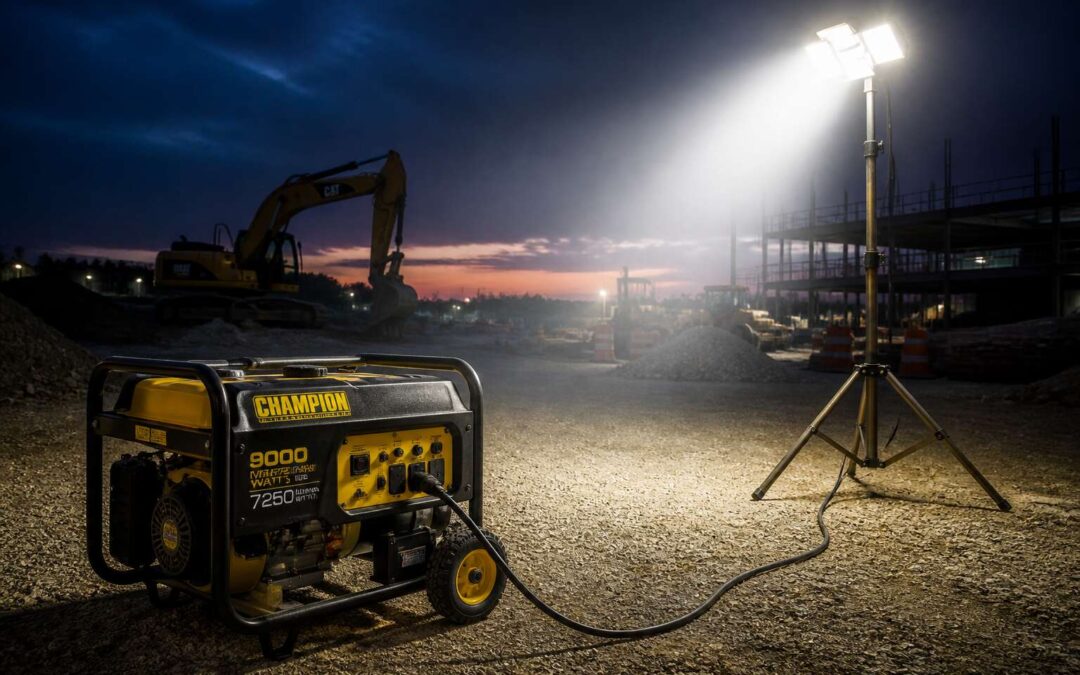
In South Africa, load shedding has rewired the way we approach after dark, but a construction deadline waits for no one. When the sun dips below the Highveld horizon, the real work begins, and the choice of a flood lights generator becomes a matter of operational survival. For sprawling sites in Sandton or dense renovations in Cape Town’s older suburbs, the power source must match the brutality of the schedule and the physical demands of the equipment. You are not just illuminating a space; you are powering a temporary ecosystem.
The energy appetite of a construction site differs vastly from a weekend braai. Heavy-duty illumination requires a sustained, reliable output that can handle banks of LED fittings or traditional metal halide lamps without faltering. When you run multiple towers for a concrete pour that cannot stop, the portability of the unit dictates your efficiency. Consider the specific tasks on site:
– Pouring foundations where shadows can hide dangerous voids.
– Interior fit-outs in multi-story buildings lacking reticulated power.
– Façade work at height requiring a precise, wide beam spread.
– Security perimeter lighting to deter theft of expensive materials.
A portable flood lights generator must offer a robust frame and a low center of gravity to traverse muddy terrain and uneven rubble. The fuel capacity becomes your silent partner, ensuring the unit runs from the first knock-off bell to the morning whistle without a refueling trip that wastes labour hours. For renovations, the physical footprint is critical; a compact, trolley-mounted unit can navigate a narrow passageway where a skid-mounted behemoth cannot go. The machine becomes a temporary utility, connected by thick, armoured cables that snake through doorways and over scaffolding. You are crafting a micro-grid that bends to the architecture of the project, not the other way around. When the unit is silenced, the only hum left should be the satisfaction of a job finished ahead of the sun. Optimize your operational uptime with a system engineered for the grit of the African job site, and ensure your supplier offers local support for parts and servicing.
Emergency and Disaster Response Situations Requiring Instant Light
When the grid fails, the first sixty seconds decide everything. Emergency responders in South Africa know that darkness turns a crisis into a catastrophe. A flood lights generator for disaster response must deliver instant light without hesitation. Diesel units struggle in cold starts, so petrol or dual fuel options often win in the field.
Consider the operational demands. A single malfunctioning unit can stall a search and rescue mission. For teams moving through collapsed structures or setting up temporary medical posts, the equipment must be compact and intuitive. The generator becomes the first line of order in chaos, and its portability dictates how fast you can establish a safe perimeter.
- Search operations in open veld
- Triage stations at accident scenes
- Command posts for municipal outages
Each scenario requires a different beam angle, but the power source stays constant. Choose a flood lights generator with electric start and a fuel gauge you trust, because in an emergency, you do not have time to troubleshoot.
Security Lighting for Warehouses, Parking Lots,and Perimeters
In the hollow silence of a warehouse district, the only sentinel is a flood lights generator humming its low, vigilant hymn. For perimeters that stretch into the black, matching portable energy to the precise geometry of darkness becomes a ritual. Security lighting demands constancy; a flicker is a confession of vulnerability. Consider the specific hungers of your space:
– Parking lots need wide, diffused pools to swallow shadows between cars.
– Perimeter fences demand a focused beam to trace the boundary without blinding the adjacent road.
– Warehouse loading bays benefit from a sharp, white glare that leaves no corner for the eye to miss.
Your flood lights generator must answer these distinct calls without hesitation, a quiet heartbeat against the encroaching night.
Recreational Use: Camping, Tailgating,and Remote Expeditions
Somewhere between the last firework and the first yawn of dawn, a flood lights generator becomes the true host of any gathering. Tailgating at Loftus or a secret spot along the Garden Route, the party does not move to the music; it moves to the light. Your portable power must match the mood. A campsite requires a soft, warm glow that keeps the darkness at the edge of the fire circle without startling the stars above the Karoo. A stadium parking lot, however, demands a clinical, white wash that turns a bakkie bed into a kitchen and a bumper into a buffet table.
For the remote expedition, weight and silence are the currency of the wild. A bulky unit is a burden; a loud one breaks the spell of the bushveld. Consider these specific recreational calls:
– A 2000 watt inverter generator can run LED flood lights while charging a fridge.
– A dual fuel model offers the flexibility of petrol or gas when you are far from a station.
– Solar hybrid systems deliver a whisper quiet hum, but they need the full sun of the day to feed the night.
The best flood lights generator for recreation is the one you barely notice until the sun abandons you. It is the quiet architect of the scene, drawing a circle of light around a camping chair or washing a tent in a flash of brilliance. Whether you are lighting a cricket pitch in the suburbs or a trailer in the Namib, your choice of energy dictates the texture of your night. It is a promise that the evening will end only when you decide it should.
Operational Best Practices and Maintenance Guidelines for Lighting Systems
Pre-Operation Inspection Checklist for Cables, Plugs,and Connections
Your flood lights generator demands a disciplined eye before it ever illuminates a site. I always begin with a pre operation inspection, because a single frayed cable can shut down an entire night shift. Follow this simple checklist to keep everything safe and reliable:
1. Check the power leads for cuts, abrasions, or exposed copper. Replace any damaged section immediately.
2. Examine each plug for corrosion. Wipe down the terminals and confirm a snug fit into the socket.
3. Tighten every connection on the alternator and transfer switch. Loose bolts create resistance, which leads to overheating and voltage drop.
Make this a five minute ritual. It saves hours of downtime later. And never ignore moisture; keep all weatherproof caps sealed. Adopt this routine and your flood lights generator will respond instantly when the sun goes down.
Proper Placement and Positioning to Maximize Light Coverage
Positioning a flood lights generator is a deliberate exercise. The angle of each lamp determines ground coverage. Place the unit too close and you create blinding glare. Too far and the beam scatters into useless ambient glow. Walk the site and identify working zones and walkways. Aim each head to overlap the next by thirty percent.
Height matters as much as angle. A unit raised to eight metres casts a wider pool but loses intensity to atmospheric scatter. For dusty South African sites, that tradeoff is real. Keep the mast vertical and lock every adjustment pin.
- Use a laser pointer to check beam angles before sunset.
- Mark the ground where each light will land.
Regular maintenance keeps the optics honest. Dirty lenses cut output by forty percent, so your flood lights generator runs longer for less light. Wipe glass panels weekly. Check the tilt mechanism for rust after Highveld thunderstorms.
Routine Maintenance: Cleaning Filters, Changing Oil,and Replacing Spark Plugs
I have watched crews skip routine maintenance on a flood lights generator until it refuses to start. That failure costs more than the service ever would. Air filters are the first casualty on dusty South African sites. A blocked filter reduces airflow, so the engine burns more fuel for less output. Clean it every week, or replace it.
Oil changes matter just as much. Old oil turns acidic and wears down moving parts. Drain and refill after the first 20 hours of operation, then stick to the manufacturer’s interval. Spark plugs also need attention. Fouled plugs cause hard starting and misfires.
Use this schedule:
- Check the air filter before each shift.
- Change oil every 100 hours.
- Replace spark plugs every 200 hours.
This routine keeps your flood lights generator honest and your worksite bright.
Safe Fuel Handling, Storage,and Refueling Procedures
Every flood lights generator demands respect for its fuel. A single careless refueling can transform one into a burning hazard! Diesel and petrol vapours ignite without warning, and a moment of distraction on a dusty South African site costs more than time. I have watched a static charge set a jerry can ablaze near a storage shed. Keep fuel in approved containers, shaded from direct sunlight, and far from any exhaust outlet.
- Switch off the generator and let it cool for ten full minutes before opening the cap.
- Wipe every spill instantly, then wait until fumes disperse before attempting a restart.
- Use a funnel, fill to 90% capacity, and secure the cap tightly after each pour.
Refuel outside on level ground, with an extinguisher within reach. Labelled containers prevent petrol and diesel from mixing, which ruins engines quietly. This disciplined routine keeps your flood lights generator roaring through the dark without turning into a liability.
Troubleshooting Common Issues: Flickering, Overheating,and Power Surges
A sudden flicker on site is often the first signal that your flood lights generator is under pressure. Loose connections and voltage fluctuations cause most lighting failures, not the lamp itself. Before each shift, inspect every plug and socket, because a single corroded pin degrades performance silently.
Overheating develops when airflow is blocked. Position the unit clear of walls and debris, and monitor the thermostat on extended runs. For power surges, the cause is usually an abrupt load change, so add high draw lights one at a time. Follow this sequence when an issue appears:
- Check the cable and connector for damage.
- Verify the generator’s output with a multimeter.
- Test the lamp separately to isolate the fault.
These simple checks keep your flood lights generator reliable through the African night.
Seasonal Storage Tips to Prolong Equipment Lifespan
In the South African bush, an hour of unplanned darkness can cost more than a repair bill. That harsh lesson shapes how I approach any flood lights generator. Operational best practices require a full-load test every two weeks, complete with thermal checks. This catches minor faults before they become costly failures.
For seasonal storage, think about the coastal humidity in Durban or the Highveld dust. A flood lights generator stored for three months needs a different routine than one used weekly. Clean the exterior, charge the battery, and add a fuel stabilizer if gasoline. Cover it with a breathable cloth, never plastic, because plastic traps condensation.
Keep a log for each session: hours run, load percentage, ambient conditions. These records reveal patterns that thermostats miss. I have seen generators last a decade beyond expectation when operators respected these rhythms.