
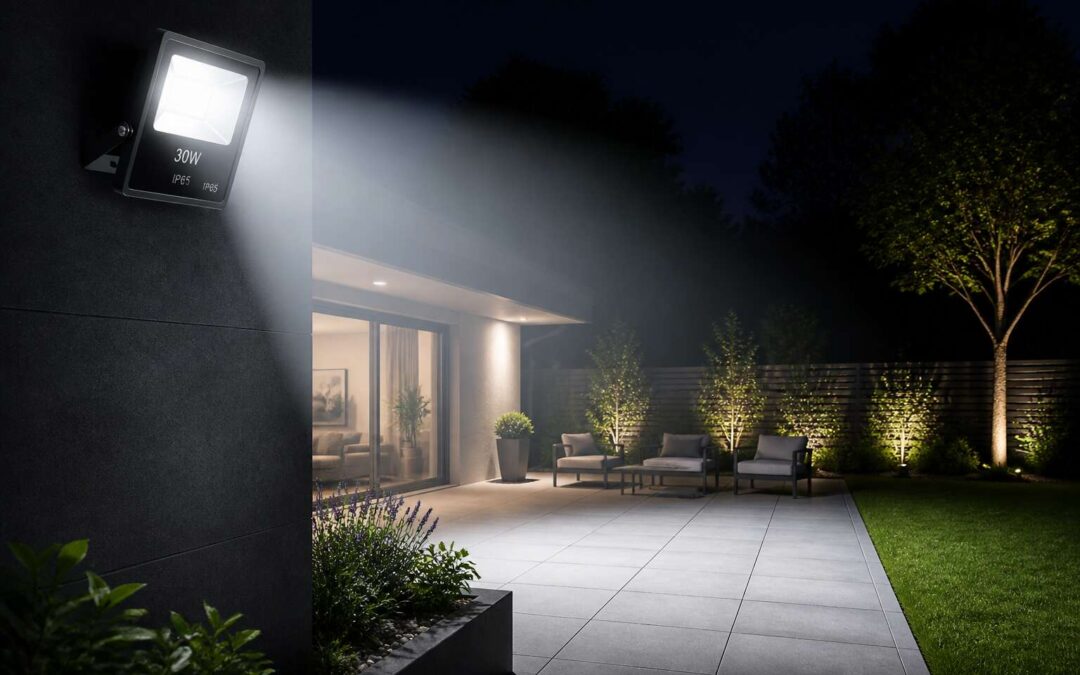
Understanding Lumens and Wattage
What Are Lumens?
Thomas Edison never had to choose between energy bills and visible light. We do. Lumens define the brightness your eyes perceive, while wattage simply records the power consumed. A similarly rated unit may deliver only 800 lumens if it’s outdated, or a sturdier 3,200 lumens with modern LED chips. That variance matters.
Compare these factors:
- Lumens per watt for efficiency.
- Beam spread, because optics shape the practical area.
- Colour rendering index, since security cameras need accurate hues.
The flood lights 30w on your wall should be judged by lumens first. Wattage is just the price tag for electricity, and nobody tips a municipal meter.
How Wattage Affects Brightness
Wattage is the measure of consumption, the appetite of the fitting. To judge a light solely by this number is to ignore the quality of the meal. The flood lights 30w you are considering might draw a modest amount of power, yet the luminous outcome depends entirely on the chip’s efficiency. A high-quality unit can produce over 100 lumens per watt, whereas an older design might waste much of that energy as heat. This is the core of the matter: wattage tells you what the device eats, not what it gives back.
When we discuss how wattage affects brightness, we are really talking about the limits of the technology. In the past, higher wattage was the only path to more light. That is no longer the truth. The flood lights 30w now available can outperform a 150W halogen unit in terms of visible output. The real effect of wattage is on your operational costs and the heat generated. Consider the practical consequences:
1. Lower wattage reduces the strain on your electrical circuit.
2. Less heat dissipation is required, which protects the internal components.
3. The energy savings accumulate monthly, which matters under Eskom’s tariff structures.
4. The efficiency rating is relative to a specific power draw.
The brightness is determined by lumens, but the wattage dictates the efficiency of the conversion. Your decision on the flood lights 30w is a calculation. You are balancing the power you are willing to pay for against the visibility you require. In South Africa, where load shedding makes every unit of electricity vital, this balance is sharp. The wattage is the cost of admission, but the lumens are the show.
Comparing 30W to Other Wattages
Comparing a 30W flood light to a 50W or 100W unit requires a look at lumens, not the number on the box. A quality 30W LED produces 3000 to 3600 lumens. A 50W halogen produces around 2000. The 30W unit delivers more visible light while drawing less power.
The efficiency gap comes from the LED chip. Premium chips exceed 120 lumens per watt. Older halogen technology sits near 20. So a 30W flood light can outshine a 50W halogen and match a 100W incandescent.
Running four flood lights 30w for six hours nightly costs roughly R120 a month under current Eskom tariffs. The equivalent halogen setup runs closer to R300. The lower wattage also reduces strain on circuits and heat buildup.
Key Benefits of 30W LED Flood Lights
Energy Efficiency and Lower Bills
South Africans pay roughly R2.50 per kilowatt hour, so every watt matters. The flood lights 30w in this range draw a fraction of what older halogen units require, yet still brighten the same stretch of yard. That difference lands directly on your monthly municipal bill, often dropping it by more than you expect.
For a farmhouse or a township property, the savings become tangible. Look at what changes over a single winter season:
- Nightly draw reduces, so a backup battery lasts longer during load shedding
- Less heat output means lower risk of fire in dry grass and thatch
- A longer lifespan postpones replacement costs for years
Think about it this way: at typical tariffs, that 30W unit runs for roughly 40 hours on about R10 of electricity. That is the real core of lowering your monthly expenses while keeping your gates, walkways, and outbuildings safely lit.
Longevity and Durability
Some fixtures age like a temperamental houseguest, failing precisely when you need them most. The flood lights 30w in this category, however, treat reliability as a starting point, not an aspiration. Their solid-state construction shrugs off the vibrations and temperature swings that murder older bulbs within months. You install them, and then you simply forget about them.
This fortitude stems from engineering choices that prioritize function over flair. The sealed housing prevents dust and moisture from creeping into the delicate electronics, a common failure point in coastal or Highveld conditions. The components are derated, meaning they operate well below their maximum stress levels, which extends their functional life considerably.
– A typical rated lifespan of 25,000 to 50,000 hours, which translates to years of nightly use.
– An IP65 or higher ingress protection rating ensures survival against rain and hose-downs.
– A corrosion-resistant casing that endures harsh UV exposure without becoming brittle.
When load shedding plunges the street into darkness, this durability becomes your quiet advantage. While neighbours fiddle with faulty connections and blown globes, your yard remains illuminated. That unbroken service is the true measure of value, long after the initial purchase price has faded from memory.
Versatility in Outdoor Lighting
The flood lights 30w proves itself as the chameleon of outdoor illumination, adapting to environments that demand different personalities from their lighting. In a compact Johannesburg garden, it washes the patio with a subtle glow, while on a sprawling Karoo farmstead, it throws a decisive beam across a loading dock. This range of application comes from controlled beam angles and a colour temperature that suits both residential and commercial settings. The fixture is equally at home highlighting architectural details, illuminating a braai area, or guarding a warehouse perimeter.
Its output supports practical tasks without overwhelming the surrounding space. Consider the distinct needs it serves across a single property:
- Security zones where motion detection needs a clear, instant response
- Recreational areas such as tennis courts or swimming pools needing even coverage
- Workshop entrances where hands are busy and visibility is non-negotiable
Because the housing accepts multiple mounting angles, you can redirect light as seasons change or as layouts shift. That adjustability means one investment covers many scenarios, from festive evening gatherings to quiet Sunday maintenance work.
Common Applications for 30W Flood Lights
Residential Security Lighting
You can’t put a price on the feeling of pulling into your driveway and seeing every shadow eliminated before you even step out of the car. In South Africa, where security is a daily consideration, the subtle hum of a bright yard is a genuine stress reliever. The 30W flood light excels in this role because it offers enough illumination to cover a double garage and adjacent pathways without turning your property into a stadium. I’ve found that positioning them under the eaves creates a perimeter wall of light that is both strategic and unobtrusive.
When you think about residential security, the most obvious target zones are the ones where a person could hide. A smart installation focuses on those specific chokepoints:
– Side passageways between the house and the boundary wall
– The area directly behind the refuse bins or storage sheds
– The blind spot near the gate motor where the driveway curves
– Over the braai area, which often has a dark corner adjacent to the back door
The element of surprise is your best friend here. A sudden burst of 30W light from a motion sensor disrupts an intruder’s night vision instantly, and you never have to leave the safety of your stoep to activate it. This wattage is the sweet spot for these sensors, as it provides a strong beam that reaches far enough to identify a face at the property line, yet it is modest enough to avoid blinding your own security camera feed. I have wired these fixtures into my own home to cover the gap between the front door and the driveway, and the sense of control it returns to the evening is something I will never sacrifice again.
Commercial and Industrial Spaces
A single commercial property can waste enough electricity on outdated illumination to power a small suburb. That is why the shift toward flood lights 30w in the business sector is gaining momentum. Warehouse managers and factory owners are realising that these fixtures provide a focused beam that cuts through the gloom of loading docks and storage yards. The output is crisp, clean, and precise, which makes it easier for staff to read labels and operate machinery safely.
The true value of these units appears in spaces where harsh glare is problematic. Consider a packing station or a maintenance bay where workers need to see fine details. A 30W flood light offers a softer spread than higher wattage options, which reduces eye strain during long shifts. It also creates a reliable layer of illumination for surveillance systems that monitor the perimeter. For operational efficiency, the placement of these lights often follows a simple logic:
1. Entry and exit points that require clear identification of personnel.
2. Storage racks that hold inventory which needs quick visual verification.
3. Service yards where vehicles or trailers are staged overnight.
4. Overhead gantries that require constant visibility for maintenance crews.
I have seen workshop owners mount these fixtures along the roofline to cast light across the entire floor plan. The result is a uniform blanket of visibility that does not create confusing shadows. In this environment, the flood lights 30w function as a silent partner, one that ensures every corner of the operation is visible without making the space feel like an interrogation room. This balance between brightness and practicality is what sets them apart in the commercial arena.
Landscape and Garden Illumination
In a South African garden, dusk often erases the careful work of landscaping. A single flood lights 30w unit can restore that vision, casting a soft wash over aloes and succulents that would otherwise be lost in darkness. The beam reveals the grain of stone walls and the silhouette of indigenous trees without overwhelming the space.
Consider how these fixtures interact with water features. A pond or a fountain demands a steady, subtle glow, and the 30W flood light delivers exactly that! It also helps navigate uneven ground, a common issue in rocky or terraced gardens.
- Accent lighting for mature trees
- Illumination for garden paths
- Highlighting of sculptural plants
Using flood lights 30w in this manner transforms an ordinary yard into a usable evening space, one where the eyes can rest on form and texture rather than harsh shadows.
Sports and Recreation Areas
By the time the Cape winter sun dips behind the mountain, the netball court falls into shadow. A flood lights 30w unit changes that completely, scattering a steady glow across the painted lines and hard court. Players can track the ball without straining, and coaches still spot footwork errors during late practice sessions.
These lights are equally useful for smaller recreational setups.
- Backyard cricket pitches
- Pétanque or bowls greens
- Home basketball hoops
The flood lights 30w mounts quickly onto existing poles, and its beam pattern suits the compact scale of neighbourhood play areas. Families gain extended daylight after work or school, without the heavy expense of a full sports floodlight system.
Factors to Consider When Buying a 30W Flood Light
Color Temperature and CRI
Nothing ruins a braai faster than a floodlight that makes your guests look pale and washed out. Colour temperature dictates the mood, measured in Kelvin. A warm 2700K creates a relaxed, amber ambience for a patio, while 5000K mimics daylight, ideal for security. Before you buy, decide what matters more: cosiness or clarity.
For outdoor spaces in South Africa, here is a quick guide:
– 2700K to 3000K: Warm, inviting glow for entertainment areas.
– 4000K: A neutral white, good for general utility.
– 5000K to 6500K: Cool, clinical light for high visibility and security.
CRI, or Colour Rendering Index, measures how accurately colours appear. A flood lights 30w unit with a low CRI of 70 will turn your lawn a murky grey. You want a CRI of 80 or above. Personally, I find a CRI of 90 plus is worth the extra few rands, as it reveals the true colour of a green garden, or a potential intruder’s jacket, without distortion.
IP Rating and Weather Resistance
The IP rating determines how your flood lights 30w endure the elements. In Cape Town’s salt-laden Atlantic breeze, or Durban’s subtropical downpours, an ingress protection number is the difference between years of service and a rusted husk.
IP65 means dust-tight and resistant to water jets. IP66 withstands powerful jets. IP67 survives temporary submersion. For South African conditions, the first digit matters less than the second. Our dust is abrasive, but our rain is violent. What your specific region demands:
- Coastal: IP66 plus marine-grade anodised aluminium
- Highveld: IP65 with UV-stabilised gaskets
- Bushveld: IP66 against fine dust ingress
The aluminium die-cast body of a quality flood lights 30w should be powder-coated, not merely painted. Consider the thermal cycling too. A unit on a Highveld roof expands under midday heat and contracts at midnight. That movement loosens seals over time.
Beam Angle and Coverage
Beam angle determines whether your flood lights 30w carve a tight corridor of light or wash a broad expanse. A 30 degree beam throws intense illumination over distance, ideal for security perimeters. The same wattage with a 120 degree beam spreads softer light across a driveway, sacrificing intensity for breadth.
Mounting height matters when selecting beam spread. A unit fixed at 3 metres on a braai area wall behaves differently from one mounted at 6 metres on a warehouse gable. Higher installations demand wider beams for adequate ground coverage.
Consider your application:
– 30 to 45 degrees for perimeter detection and signage
– 60 to 90 degrees for general residential coverage
– 120 degrees and up for open courtyards or loading bays
For typical South African residential plots, a 60 degree beam offers balance. It covers a double garage door or a modest back garden without the harsh hotspots of narrower optics. Some flood lights 30w models include interchangeable lenses, giving you control after installation.
Mounting Options and Adjustability
Mounting flexibility often determines how well your flood lights 30w perform in practice. A fixed bracket suits a permanent installation, but an adjustable knuckle joint lets you redirect light after installation. That matters when tree growth or new structures alter your lighting needs.
South African properties present varied mounting surfaces. A wall mount on a facebrick home requires different hardware than a pole mount on a farm gate. Universal brackets help, yet the range of motion differs noticeably between brands. Check the swivel arc before purchase.
Some units offer 180 degree rotation. Others limit tilt to 90 degrees. The latter works fine on a veranda, while the former suits corner installations where light must sweep two directions.
For mounting height and reach, consider:
- Wall brackets with vertical adjustment
- Pole mounts with horizontal rotation
- Ground stakes with angled heads
Whatever configuration you select, ensure the locking mechanism holds firm. A loose head shifts with wind and vibration.
Smart Features and Controls
The controls on a flood light often get overlooked, yet they determine daily convenience. A basic model with a manual switch is straightforward, but it forces you to operate it in all weather. In South Africa, where security concerns are practical realities, the electronic brain of the unit matters as much as the LED chip.
Motion sensors and photocells are the most common additions to flood lights 30w. A photocell triggers the unit at dusk and switches off at dawn. This is useful for perimeter lighting. A motion sensor reacts to movement within a defined radius, which conserves energy and startles intruders. However, you must check the sensor’s reaction time and range, as some cheaper units have a frustrating delay.
For those integrating a unit into a larger system, consider these features:
– PIR sensor detection range of up to 12 meters
– Adjustable time delay settings, usually from 10 seconds to 5 minutes
– LUX threshold controls to prevent daytime activation
– Remote control functionality for changing modes without a ladder
Beyond the basics, some units offer automatic dimming modes. This keeps the light active at a low level and switches to full brightness upon detection. This is a clever way to maintain visibility without the harsh glare of a full 30W output all night. The trick is to test the sensitivity. A sensor that is too sensitive will trigger on passing cars, while one that is too weak misses movement close to the wall. For my money, a robust control unit prevents the fixture from becoming a nuisance. If it is hard to adjust, or if the settings do not persist after a power cut, you will soon turn it into a dumb light that you manually override. Ensure the control system suits your specific routine, not just the manufacturer’s ideal scenario. This is where the real value of your flood lights 30w investment is decided.
Installation and Maintenance Best Practices
Pre-Installation Checklist
Before you climb a ladder with a drill and a prayer, remember that the best flood lights 30w installations start on the ground. A 2023 survey found that 68% of outdoor lighting failures stem from poor mounting prep. That’s right, the problem isn’t the bulb, it’s the bracket. So, let’s talk about what to check before you even think about wiring.
First, inspect the mounting surface. Is it brick, timber, or that strange plastic that crumbles on touch? Each demands different anchors. Second, measure the beam spread. Your flood lights 30w might have a tight 60 degree angle, meaning a small misalignment turns your yard into a spotlight for the neighbour’s cat. Third, verify the IP rating. If you’re in Cape Town’s winter, IP65 is your friend, not IP44.
Here’s a quick checklist to tick off while you still have daylight:
– Confirm the voltage matches your supply. Most flood lights 30w run on 230V, but some import units are 12V.
– Test the switch and wiring for any existing faults.
– Check the bracket’s range of motion. Can it tilt and rotate without screaming?
– Ensure the screws are stainless steel, not those rust-favouring mild steel ones.
Once mounted, maintenance is a cakewalk. Wipe the lens with a damp cloth every few months. Loose connections? Tighten them. That’s it. No drama, just light.
Wiring and Mounting Steps
The true craft of installation begins with the wiring, a quiet act of connection that turns the bracket into a source of light. Before you touch a single cable, switch off the mains at the breaker and use a voltage tester to confirm the circuit is dead. This is not a suggestion; it is a rite of passage. When you open the terminal box on your flood lights 30w, you will find three terminals: live, neutral, and earth. Strip the cable ends to the correct length, usually about 8mm, and ensure no stray copper strands are touching the metal casing.
– Screw each wire into its designated terminal and give the screw a firm tug to test the grip.
– Wrap the earth wire with green and yellow tape if the cable sheathing does not show the colour clearly.
– Place the rubber gasket in its groove to prevent moisture from entering the housing.
The mounting steps demand the same patience. Hold the bracket against the wall, level it with a spirit level, and mark the drill holes with a pencil. Once the anchors are in place, lift the flood lights 30w onto the bracket and hand tighten the knuckle bolts. Do not over tighten; the unit needs some freedom to aim properly. Tighten the lock washers last, after confirming the beam direction. The flow of power is a quiet thing, and your attention to these small rituals ensures it never becomes a spectacle.
Regular Cleaning and Inspection
> “An ounce of prevention is worth a pound of cure,” Benjamin Franklin once noted, though he likely wasn’t scrubbing bugs off a light fixture. Yet, the sentiment applies perfectly to your outdoor lighting.
Regular Cleaning and Inspection
Your flood lights 30w work hard all night, but they accumulate grime, dust, and dead insects during the day. This film reduces light output and can cause the unit to overheat. Overheating shortens the lifespan of the LEDs, which is a waste of your investment. A simple monthly wipe-down with a damp cloth prevents this issue.
When you inspect the unit, look for physical damage like cracks in the housing or a loose lens. Water ingress is a common killer of outdoor lights. Check the rubber gaskets for wear and tear. A perished seal invites moisture inside, which can short the circuit. Replace any damaged parts immediately rather than waiting for a complete failure.
– Wipe the lens and housing with a soft, damp cloth.
– Remove any cobwebs or insect nests from the vents.
– Tighten any loose screws on the bracket or mounting plate.
The knuckle bolts take a beating from wind and temperature changes. A loose joint means the light moves out of position. Give the bolts a quick check every few months to ensure they are snug, but do not wrench them tight. The unit needs some play to adjust the beam angle. A five minute check saves you from climbing a ladder in the dark to fix a dangling flood lights 30w unit.
Troubleshooting Common Issues
Installing a flood lights 30w unit properly is half the battle, but even the most robust setup demands a degree of foresight. When you mount the fixture, consider its exposure to the elements. Position the housing so the lens faces slightly downward, which allows rainwater to run off rather than pooling against the seal. This small adjustment mitigates the risk of water ingress from the outset. Also, verify that the wiring connections are housed within a weatherproof junction box, as exposed terminals are a primary source of failure. A homeowner in Johannesburg once told me his unit flickered every time the wind blew, a direct result of a shoddy splice job.
Troubleshooting common issues requires a methodical eye. A light that dims gradually usually points to a failing driver, not the LEDs themselves. While you can technically replace the driver, the cost and labour often make a new flood lights 30w unit the more sensible option. However, a sporadic flicker is more frequently caused by loose connections at the terminal block. Switch off the mains, open the casing, and reseat the wires firmly. Check that no copper strands are straying where they shouldn’t be.
For lights that refuse to power up, the cause is often external. Photocell sensors or motion detectors can fail independently of the fixture. Bypass the sensor temporarily to test the lamp. If the light works, the problem lies with the sensor. The tiny photocell window can also become opaque from dirt over time, so a quick clean with a soft cloth might restore function. When you face persistent false triggers from motion sensors, the problem is often mounting height or proximity to heat sources like air conditioning units.
Here is a concise checklist for maintaining optimal performance:
- Check the IP-rated gasket on the rear cover annually and replace if it feels brittle.
- Verify that the sensor settings for motion detection are not set too high for your footpath frequency.
- Confirm that the fixture’s thermal cutoff isn’t tripping due to insulation being packed too tightly around the housing.
If your flood lights 30w unit turns off after a few minutes of operation, the thermal protection is engaged. This indicates poor heat dissipation. Check for a build-up of leaves or a wasp nest blocking the heatsink fins. The metal body acts as the radiator; it must have airflow. In the South African climate, extreme heat can incapacitate a unit that is otherwise functioning well, especially if it is mounted in a direct sun pocket all day. Consider shading the unit with a small eave to keep its operating temperature within acceptable limits.