
Types of Airfield Floodlighting
Runway Edge Lighting Systems
The runway edge lighting system comprises several distinct types. These lights demarcate the operational boundaries of the runway. Elevated lights, mounted on frangible posts, emit a bright white beam. They suit primary runways where long-distance visibility is crucial. Inset lights, by contrast, are embedded into the surface. Their flush design reduces obstruction risk for aircraft tyres, but they require frequent cleaning. I have seen both deployed across South African airports!
- Elevated lights: provide a wider beam angle.
- Inset lights: withstand heavy aircraft loads.
Colour coding further differentiates the systems. White marks the edge, amber signals caution in the final 600 metres, and red indicates a displaced threshold. For flood lights aviation, selecting the right combination ensures safe operations during night landings.
Approach Lighting Configurations
When I watch an aircraft line up for final approach at OR Tambo, the approach lighting configuration does the heavy lifting. In flood lights aviation, these systems extend from the threshold into the darkness, creating a visual corridor.
The simplest layout is SALS, a row of lights paired with a crossbar. It guides pilots on non precision approaches. For bigger jets, the configuration grows. MALSF adds a sequenced flashing component, a bright pulse travelling toward the runway. The rabbit, as pilots call it, locks attention instantly. IALS offers high intensity bars that cut through Highveld fog.
Key configurations include:
– PAPI, four lights showing red or white, confirming glide slope
– Centreline lights that mark the extended runway axis
– Crossbars that provide roll guidance
Each element gets a heavy machine from cloud base to tarmac, and flood lights aviation makes that possible across South Africa.
Heliport Floodlight Requirements
The helipad sits in total darkness until the rotor wash kicks up dust. That is when flood lights aviation earns its keep. Unlike the long, structured corridors of a runway approach, a heliport demands a tighter, more immediate solution. Fixed-wing aircraft rely on depth perception over kilometers. A helicopter pilot needs to judge a touchdown zone measured in meters. This requires a different breed of lighting entirely.
For most South African heliports, particularly those at hospitals or offshore platforms, the system hinges on a few critical components:
– Perimeter lights that define the exact touchdown and lift-off area
– Floodlights arranged to illuminate the pad without blinding the pilot during descent
– An aiming point marker, often a distinct colour, to give a final visual cue
The floodlights themselves are not simple poles in the ground. They are often lowered or recessed to avoid interference with the rotor disc. The intensity needs to be high enough to penetrate dust and mist, yet controlled enough to prevent glare. A pilot coming into a rig at night is balancing a machine that wants to hover and a surface that wants to disappear. The right lighting makes that surface solid and permanent. Every unit in the flood lights aviation setup is positioned with a specific angle, calculated to wash the deck in even, white light. There is no room for shadows here. A shadow on a helipad can distort the pilot’s perception of height, turning a routine landing into a hard, dangerous touchdown. The focus is on total visibility, from the moment the aircraft crosses the boundary to the instant the skids touch down.
Taxiway Illumination Solutions
Taxiways present their own peculiar puzzle for flood lights aviation. A pilot leaving the runway needs to maintain orientation while moving at slower speeds, often in reverse or with limited forward visibility. The lighting solution here leans on low mounted floodlights that cast a wide, flat beam across the pavement.
Several configurations work well for South African airfields:
- Elevated floodlights on short masts, angled downward to trace the taxiway centreline
- Inground fixtures that sit flush with the surface, resisting damage from aircraft tyres
- Perimeter floodlights that define the taxiway edges without creating pools of glare
The goal is continuity. A taxiway that fades into darkness mid turn forces the pilot to stop and reassess, which is dangerous in tight apron areas. Flood lights aviation planning for taxiways focuses on steady, uniform wash that holds from the runway exit all the way to the parking bay.
Apron and Ramp Floodlighting
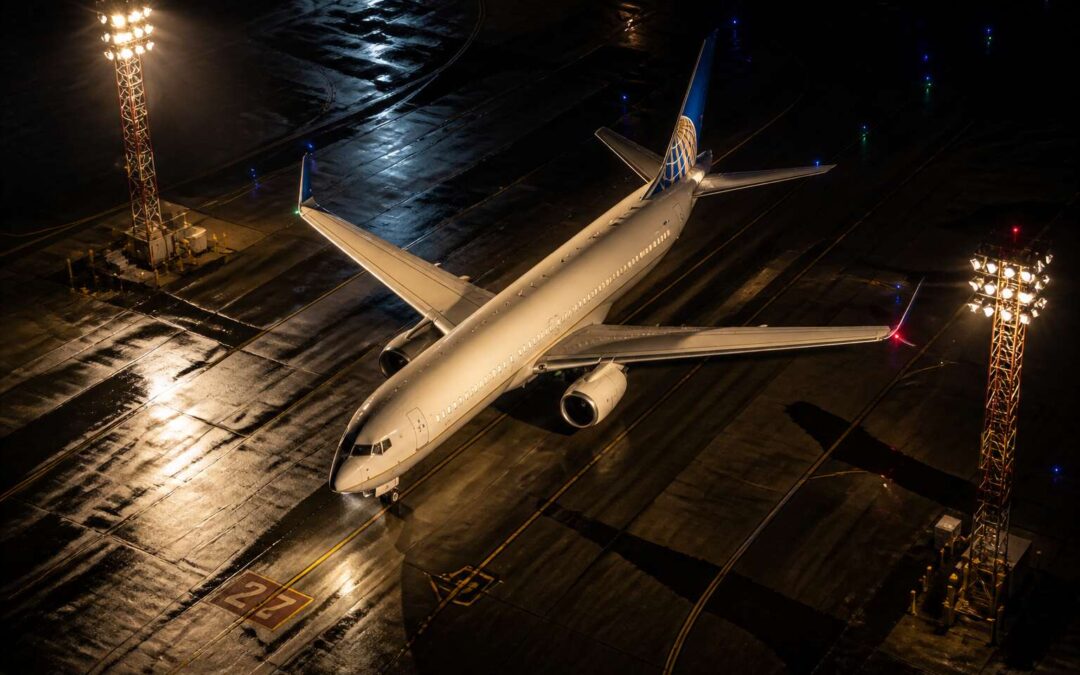
Apron flood lights aviation meets its sternest test in the hours after midnight, when a tired pilot’s depth perception starts to falter. Ramp areas are not simply open ground; they are dense zones where ground crew, fuel trucks, and baggage carts move beneath aircraft wings. The lighting must reveal the full geometry of the aircraft, including the tail and wingtips, without casting long shadows that mimic obstacles.
Uniform vertical illumination matters more than raw brightness. High mast towers, often positioned at the edge of the apron, project light across wide arcs. A mix of symmetrical and asymmetrical distributions keeps the human eye from fatiguing quickly.
- High mast towers for broad coverage
- Glare controlled floodlights aimed at fuselage panels
- Pole mounted fixtures with individual aiming protocols
Every fixture placement alters a pilot’s sense of scale. Flood lights aviation for aprons must treat the ramp as a three dimensional space, because the difference between a safe turn and a collision often lives in a single peripheral shadow.
Aviation Lighting Technologies and Standards
LED vs Conventional Light Sources
LED floodlights consume up to 60% less power than conventional quartz units while delivering identical photometric output! That difference has forced South African regulators to rethink specifications, and the result is a cleaner set of standards for flood lights aviation. Unlike older halogen arrays, LED modules require thermal design to maintain rated lifespan.
Conventional sources still appear in many aprons, mainly because of lower upfront cost. Maintenance records tell a different story. A halogen lamp may last 2,000 hours, while an LED module can exceed 50,000 hours. That gap changes operational planning.
- Instant restrike: LEDs switch on at full power, unlike halogens that need cooldown
- Dimming control: LED drivers allow precise intensity adjustments for air traffic control
- Failure mode: LEDs fail gradually, halogens fail catastrophically
Standards committees in South Africa are aligning with global photometric tests, so operators audit their kit before renewing any flood lights aviation installation.
ICAO and FAA Compliance Criteria
International compliance is rarely about aesthetics. ICAO Annex 14 and FAA Advisory Circular 150/5345-53 set precise thresholds for intensity, uniformity, and glare. These documents govern flood lights aviation installations from threshold to apron, and South African operators must reconcile local regulations with these global benchmarks.
The FAA requires photometric testing under controlled temperatures, while ICAO emphasises chromaticity coordinates. A discrepancy in beam spread or colour can fail an audit. Common audit points include:
- average illuminance over the designated area
- maximum to minimum uniformity ratio
- glare control for pilots and ground crew
Each criterion affects operational safety. A flood lights aviation system that meets one standard may fail another, so operators need comparative analysis before procurement.
Photometric Performance and Beam Angles
A 2 degree shift in beam angle can cut illuminance on a taxiway by 40%, the difference between passing and failing a photometric audit. Beam spread and orientation determine whether a flood lights aviation system serves its purpose or merely burns electricity.
In my experience, lux values in a catalogue rarely match real conditions. Mounting height, tilt, and surrounding structures all skew the numbers. That is why photometric files matter more than glossy product sheets.
Review these before purchase:
- beam centre intensity in candela
- field angle at 10% of peak output
- maximum to minimum uniformity ratio
South African operators should demand IES or LDT files and compare them against actual site dimensions. Reflection from wet runways and spill beyond the apron can shift the effective beam profile. A flood lights aviation system must be assessed in context, not in isolation.
Electrical Protection and Bonding
An electrical failure on the apron isn’t just a maintenance headache, it’s a safety liability that can ground operations for hours and cost millions in lost turnaround time. South African thunderstorms are relentless, and each strike sends a surge through the earth looking for the weakest point. That weak point is often the tower structure of a flood lights aviation system if bonding is treated as an afterthought. Proper earthing is the first line of defence, and it must follow SANS 62305 to the letter. Equipotential bonding prevents dangerous potential differences between the steel mast, the luminaire housing, and the control cabling.
The realities of a highveld storm demand more than standard practice. Your flood lights aviation installation needs a robust surge protection strategy because induced transients travel along the supply lines and enter the drivers.
A comprehensive approach includes:
– Copper earth electrodes with a resistance below 10 ohms
– Type 1 and Type 2 surge arrestors at the main distribution board
– Dedicated earth rods spaced at intervals along the cable trench
Without this layered defence, the control gear fails silently, leaving pilots in the dark during final approach. Bonding every non-current carrying metal part creates one continuous path to ground and eliminates the risk of arcing. The physical separation between the lighting circuit and the data cables prevents interference that corrupts control signals. Only by scrutinising the complete electrical loop, from the substation to the lamp head, can an operator claim that the flood lights aviation asset will remain reliable when it matters most.
Installation and Maintenance Strategies
Optimal Mounting Heights and Angles
Mounting height shapes the performance of flood lights aviation installations across South African airfields. Higher masts reduce pilot glare but require calculated tilt angles. A 20 metre pole set at 15 degrees downward delivers a tight beam footprint, while lower mounts need precise calibration to prevent dark zones.
Maintenance strategies for flood lights aviation systems must consider vibration and thermal cycling. Loose gimbals shift the beam centre over time, so quarterly inspections should verify the aiming azimuth. We have seen coastal corrosion accelerate hinge wear, which is why stainless steel fasteners matter during retrofits.
Standard installations use these aiming parameters:
- Place the flood light 45 degrees to the aircraft nose
- Keep vertical spread within 10 degrees above horizontal
- Set the pole back at least 7 metres from the parking line
Regular cleaning of the tempered glass lenses preserves lumen output and sustains the expected photometric pattern.
Power Distribution and Redundancy
In African aviation, power reliability is not a luxury; it is the invisible hand that holds a pilot’s approach together. A single electrical fault in your flood lights aviation system can turn a familiar runway into an uncertain patch of darkness. This is why power distribution demands more forethought than simply running a cable from the nearest mast. You must treat each circuit as a lifeline, with dedicated breakers and isolation switches that allow for safe maintenance without plunging the entire apron into shadow.
Redundancy is your silent copilot. A proper strategy involves dual feeds from separate substations or at least distinct transformer banks. Consider these options for your site:
– Uninterruptible power supply units to bridge the gap between grid loss and generator start-up.
– Automatic transfer switches that test themselves weekly to ensure they will not fail when called upon.
– A portable generator connection point, hardwired into the distribution board for rapid deployment.
South Africa’s grid conditions are volatile, so your system must be designed to withstand flicker and surges. We have seen poorly specified drivers burn out LED arrays not because of heat, but because of inconsistent voltage. The remedy is robust surge protection at the distribution board, not just at the fixture.
Monitoring is where true wisdom lies. Install current sensors to track each circuit’s draw. A sudden increase in amperage often signifies a failing ballast or a degradation in the lamp, alerting you to a problem long before the beam dies completely. In this way, your electrical network becomes a diagnostic tool, telling you the health of your flood lights aviation infrastructure through the language of power and current. This diligence ensures that the precise aiming angles we discussed previously become more than just an installation target; they become a sustained beacon of safety.
Scheduled Cleaning and Inspection
Dust robs light. A thin layer of Highveld grit can cut a floodlight’s output by 30% within a fortnight. Scheduled cleaning is photometric hygiene for your flood lights aviation network. Use a non abrasive cloth and reapply hydrophobic coatings after each wash. Skip the pressure washer; it forces moisture past the IP rated seals.
Quarterly inspection catches trouble before it closes the runway. Check these:
- Torque the mounting bolts; generator vibration loosens them silently.
- Thermal scan the LED array for failing solder joints.
A corroded connector shows up in amperage draw long before the beam fades. That moment makes your monitoring investment worthwhile.
Fault Diagnosis and Replacement
Most flood lights aviation failures are seeded on installation day. Cable glands torqued to the wrong spec let the Highveld air breathe in and out. By the second winter, moisture has turned a connector pin to powder. It starts with a flicker faintly visible at dawn, then the circuit breaker trips at 2 a.m.
Fault diagnosis should follow a strict sequence:
- Measure voltage at the terminal block, not the panel.
- Clamp the amperage draw per fitting.
- Run a Megger test to expose insulation breakdown.
That final test catches failures that hide behind normal readings.
Replacement rarely demands a complete unit. Modular drivers and LED arrays can be exchanged inside the flood lights aviation housing. Keep spares matched for colour temperature and beam spread. A mismatched swap leaves a visible seam in the pavement coverage, and that seam becomes the next incident site.
Upgrading Legacy Systems
I have learned to inspect the plinth before anything else. The real cost of upgrading legacy flood lights aviation units appears in the infrastructure, not the luminaire price. A thirty year old high mast often has corroded internal ladders and cable trays sized for the old halogen drivers. Replacing the units without addressing these parts simply shifts the failure point downstream.
One Johannesburg site taught me the full sequence for these flood lights aviation upgrades:
- whether the existing winch system can lower a heavier LED frame
- if the earthing network meets the higher leakage current demands
- that the control cabinet has spare capacity for emergency switching
The cabinet failed that final check. Everything else looked perfect, but the upgrade stalled for a week while we installed a second distribution board. That week was cheaper than a mid-winter shutdown.
Safety During Installation
Most flood lights aviation failures trace back to the day of installation, not years later. I have watched crews rush a mounting bracket and pay for it with a collapsed mast. The safest approach treats every lift, every bolt, and every connection as a single point of failure.
Before any work begins, we verify the lifting plan against actual wind conditions. Johannesburg afternoons bring gusts that exceed crane tolerances. We rig the frame, then we wait for the weather window. There is no shame in a late start.
- Lock out the supply and tag the isolator before any hands touch the luminaire.
- Check the winch drum and cable for wear on every lowering cycle.
- Secure the frame with a secondary sling while making electrical connections.
Slings, harnesses, and voltage testers cost little. A broken neck or a flash burn costs everything. Safety during installation is the one strategy that never changes for flood lights aviation, no matter the site or the season.
Operational and Environmental Factors
Pilot Glare and Visual Comfort
On a misty Lowveld evening, light behaves differently. It refracts, scatters, and clings to moisture. Flood lights aviation systems that appear flawless on a clear Highveld night can suddenly become a source of pilot glare. That shift is the core operational dilemma. Glare is about contrast, not raw brightness. When surrounding terrain is dark and rain-soaked, any intense source triggers visual discomfort.
The pilot’s eye must adapt quickly between dark cockpit and bright apron. South African conditions, from Harmattan dust to subtropical thunderstorms, demand fixtures with adjustable intensity and careful aiming. A polished reflector angled too high defeats its purpose entirely.
Consider what changes the visual picture:
– Precipitation and fog scatter light into droplets of haze
– Airborne dust creates a luminous veil across the approach
– Background lighting from urban sprawl reduces runway contrast
– Wet asphalt produces specular reflection that mimics signal lights
These factors force flood lights aviation designers to prioritise adaptive control. Reducing upward spill light and providing smooth dimming curves help maintain visual comfort without sacrificing safety. It is a delicate balance, yet vital for every night operation.
Wildlife Deterrence Strategies
In South Africa, flood lights aviation infrastructure often overlaps with unforgiving bushveld environments. Light pools create unintended ecosystems. Insects gather beneath the glow, attracting owls, bats, and smaller predators that become hazards for inbound aircraft.
Wildlife deterrence requires a deliberate approach:
- Recessed housing to minimise glare corridors along fence lines
- Switching schedules that avoid peak nocturnal movement
- Infrared sensors tied to perimeter lighting warnings
Adjusting flood lights aviation intensity based on seasonal patterns is not merely a maintenance task. It is operational intelligence. A softer beam during migration windows and sharper illumination during scheduled movements keeps wildlife unpredictable, which is exactly what airside safety demands.
Weather Resistance and Corrosion Protection
I have seen flood lights aviation fitted with the best lamps on the market, only to have the housings fail within a year. Salt air, Highveld thunderstorms, and airborne dust conspire against luminaires in ways that photometric data never predicts. A fixture’s ingress protection rating tells you about laboratory conditions; it says nothing about a decade of Karoo grit.
The South African environment is uniquely punishing. Coastal airports battle chloride corrosion that creeps into junction boxes. Inland strips face UV degradation that turns polycarbonate lenses brittle. The realities of corrosion protection demand more than a powder coat finish.
– Marine grade aluminium housings with chromate conversion coatings
– Stainless steel fasteners for every hinge and latch, without exception
– Gaskets that compress, not just sit, under pressure
– Sealed optical chambers with active moisture drainage paths
Hot-dip galvanised mounting brackets matter as much as the lamp itself. Anodes on the supporting steelwork cost little compared to the headache of a collapsed mast during a storm. The operational mandate is simple: flood lights aviation infrastructure must survive on the coast and in the bush, with the same predictability you expect from a sunrise. Weather resistance is not an accessory, it is the difference between a scheduled departure and a night spent staring at a dark apron.
Energy Management and Smart Controls
Every runway apron holds a quiet energy appetite, and flood lights aviation systems are often the biggest diners at that table. In South Africa, where load shedding interrupts the grid with stubborn regularity, smart controls are no longer a luxury. They are the difference between a lit circuit and a dark one.
Energy management starts with understanding the environment. Coastal mist, Highveld storms, and Harmattan dust change how light scatters. A smart controller reads these conditions through ambient sensors and adjusts output accordingly. Instead of running full power on a clear night, the system dims to the photometric minimum. That routine tweak trims kilowatt-hours without compromising visibility.
- Daylight harvesting that turns off fixtures when dawn leaks over the horizon
- Occupancy detection for aprons, so idle bays do not burn brightness
- Voltage regulation that protects lamps from Eskom’s infamous surges
The magic lies in the communication layer. Centralised software monitors each luminaire’s health and energy draw, flagging anomalies before they become failures. For flood lights aviation, this means predictable performance during critical windows and lower municipal bills throughout the year. It is control, not complexity, that keeps the apron glowing with purpose.
Selecting and Sourcing Floodlight Equipment
Key Specification Parameters
The procurement of flood lights aviation equipment is often where the best laid plans for an airfield encounter reality. While photometric data promises performance, the actual delivered solution is a negotiation between available budgets, supplier lead times, and specific aerodynamic constraints. A specification sheet is only the first draft of a conversation; the final product must withstand local weather patterns and fluctuating power grids without compromising operational readiness.
Engaging with suppliers requires a precise understanding of your liability. When specifying flood lights aviation systems, a focus on the interface between the luminaire and its mounting structure is essential. Consider the total cost of ownership, which includes logistics and customs clearance into South Africa.
Key specification parameters to prioritize during sourcing:
– Thermal management ratings for high ambient temperatures
– Ingress protection (IP) ratings specifically for dust and driving rain
– Vibration damping characteristics for tower mounted units
– Compatibility with existing control and monitoring protocols
The most resilient equipment programs are those that demand proof of warranty support and local service availability. A unit that cannot be repaired within the airfield’s turnaround schedule is a liability, regardless of its initial brilliance. The goal is to secure a solution where the hardware and the aftermarket support are engineered to function as a single, reliable system.
Finally, the sourcing process must account for integration with other airport systems. The physical dimensions and connector types of your chosen flood lights aviation models must align with retrofit infrastructure and future smart control networks. This diligence prevents the common pitfall of owning advanced technology that cannot be installed seamlessly or operated efficiently. It is this practical foresight that separates a successful lighting upgrade from a prolonged engineering headache.
Vendor Qualification and Testing
Supplier qualification demands more than reviewing brochures. A vendor’s testing protocol reveals their commitment to real-world performance. Ask for factory test reports, not just photometric files. For flood lights aviation procurement, the gap between a passing lab result and a durable installation often shows up during environmental stress screening.
Consider these qualification checks:
– Verify ISO 9001 certification and traceable calibration records
– Request witness testing for thermal and ingress protection
– Confirm the supplier’s testing lab holds SANAS accreditation
A credible source welcomes this scrutiny. Resistance to inspection warrants caution. The procurement team should also inspect sample units under operating conditions. Testing installations at the airfield before full rollout exposes compatibility issues that paper specifications miss. South African conditions, with high UV exposure and intense storms, demand proof beyond the datasheet.
Cost-Benefit Analysis
In South Africa, the total cost of ownership for flood lights aviation spans far beyond the purchase invoice. Energy tariffs climb annually, and maintenance crews are scarce. A luminaire that saves 15% on power consumption but requires quarterly servicing may cost more over a decade than a pricier unit that operates unattended for five years. The initial price difference often fades when considering electrical protection requirements and replacement logistics.
When comparing bids, consider these factors:
- Spare part availability and local lead times
- Warranty conditions tied to performance guarantees
- Technical support capacity within South Africa
The cheapest tender often conceals the highest operational risk. A robust cost benefit analysis weighs replacement intervals, cleaning cycles, and tariff structures against the initial capital outlay. For flood lights aviation procurement in South Africa, the decisive metric is cost per lux per operational hour, not the unit price. That single figure reveals whether a bargain truly serves the airfield’s budget over a twenty year horizon.
Lifecycle and Warranty Considerations
A procurement officer once told me that the real lifespan of a floodlight begins the day the warranty expires. That truth shapes how we approach flood lights aviation equipment selection. A five year warranty means nothing if the manufacturer cannot honour it from Johannesburg or Cape Town!
Sourcing decisions should hinge on lifecycle evidence, not promises. Ask for field failure data from similar climates. Verify that spare drivers and optics will exist in ten years. Warranty terms must align with photometric decay thresholds, otherwise you inherit the risk.
Local technical support determines whether a minor fault becomes a three week shutdown. In South Africa, the gap between a robust luminaire and a fragile one only reveals itself after years of Highveld thunderstorms and coastal salt exposure.