
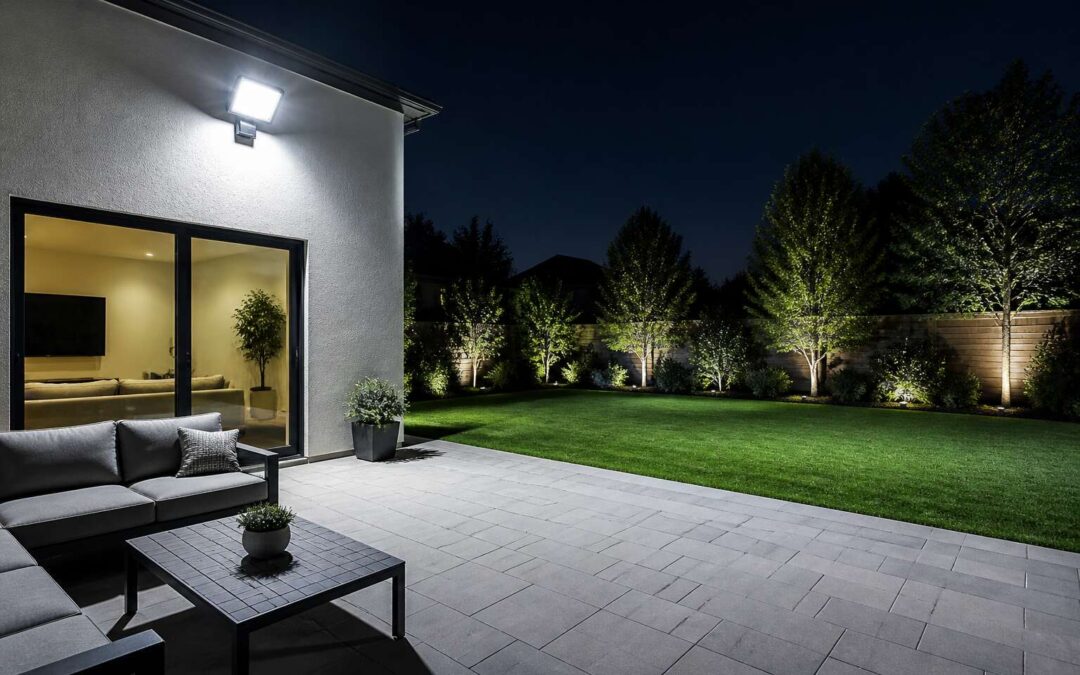
Understanding 5000K Floodlight Technology
What Does 5000K Mean in Lighting?
In South Africa, security and visibility go hand in hand. The term 5000K describes the colour temperature of light, not its brightness. This is a common misconception. Lumen output measures intensity, while Kelvin measures hue. At 5000K, flood lights 5000k produce a neutral white beam that closely resembles natural daylight at noon. It sits between warm indoor lighting and the harsh blue of higher Kelvin ratings.
This spectrum matters because our eyes are wired to respond to it. Colours appear more accurate. Shadows become sharper. Objects in the distance lose their murky edges. For property owners, that translates to a clearer view of driveways, entrances, and perimeters.
- CCTV cameras capture clearer footage under 5000K
- Foliage and pathways are easier to distinguish
- Glare stays manageable compared to cooler sources
The practical result is a flood light that feels like morning light, held steady through the night. That is what 5000K means in real terms.
Color Temperature vs. Brightness
Kelvin and lumens are independent variables in every LED fixture. One controls colour. The other controls output. That separation is engineered, not accidental. Manufacturers apply phosphor coatings to LED chips to set the colour temperature. Brightness comes from drive current and thermal design. I have watched buyers fixate on the Kelvin number while the lumen rating does the real work. The two systems never constrain each other.
Practical effects follow:
- Lumens dictate throw distance and coverage area
- Kelvin dictates how accurately surfaces and shadows render
For flood lights 5000k, this means the daylight colour does not reduce brightness. A 200W fixture at 5000K radiates the same total light as a 200W fixture at 3000K. The spectrum differs. The energy does not. That is why flood lights 5000k suit security installations: you keep the lumen output you paid for and gain the crisp, neutral tone that South African conditions demand.
LED vs. Halogen Floodlights
The technology inside a 5000K floodlight is a study in controlled physics. Rather than heating a wire until it glows, these fixtures coax light from a semiconductor via electroluminescence. The result is a very different beast from the halogen lamps many South African properties still rely on.
Halogen units are essentially miniature furnaces. They push vast amounts of electricity into a filament, producing immense heat that creates light as a byproduct. A 5000K LED, by contrast, produces light as the primary function. The housing stays cooler, the driver manages power, and the optical lens directs the beam with precision.
– LED fixtures convert a higher percentage of energy directly into light.
– Halogens waste up to 90% of their input on thermal radiation.
– A 5000K LED holds its spectrum across its lifespan, while halogen shifts warmer as it ages.
This engineering distance matters. When you walk a perimeter at night, security flood lights 5000k reveal textures in greys and stark whites that halogens blur into a muddy amber. The technology is not merely newer, it is fundamentally different in how it treats electrical energy. For anyone tired of replacing bulbs, the choice is a quiet but definitive shift.
Beam Angle and Light Distribution
The beam angle is one of the most ignored specifications on a floodlight box. A narrow beam of 15 degrees throws light far down a driveway, while a 120 degree spread floods an entire yard. Lenses and reflectors shape the distribution, deciding where the lux actually lands.
Flood lights 5000k with asymmetric optics push illumination downward and outward, reducing glare for neighbours on South African properties. This matters when stands are irregular and boundary lines sit close to the house, a situation I see often.
- Narrow beams (15 to 30 degrees) suit long driveways and perimeter walls
- Medium beams (60 to 90 degrees) cover parking areas and entrances
- Wide beams (120 degrees plus) handle open gardens and barns
The right pattern for flood lights 5000k prevents dark pockets and wasteful spill, which is the real difference between a security setup that works and one that merely glows!
Key Benefits of Upgrading to 5000K Outdoor Lighting
Superior Visibility and Security
Under the cloak of a South African night, the distinction between a shadow and a threat becomes dangerously blurred. The transition to flood lights 5000k is a declaration that darkness will no longer dictate the terms of your safety. This specific Kelvin rating delivers a brilliant, white light that makes motion detection in and around the garden more accurate, reducing false alarms caused by shifting shadows.
The true advantage lies in how this luminance affects human perception. Security cameras paired with these fixtures capture sharper, more detailed images because the light spectrum mimics daylight, allowing for precise identification of faces and vehicle plates. To fully appreciate the leap in quality, consider the functional gains:
– Significantly enhanced color rendering for clear surveillance footage.
– Reduction of eye strain when moving between interior and exterior spaces.
– Improved peripheral awareness that standard warm lights fail to provide.
This upgrade moves beyond simple deterrent value. It creates an environment where homeowners feel a measurable sense of control. The crisp output of flood lights 5000k empowers you to see the intruder before they see you, transforming your property into a less appealing target. Whereas softer lights often cast confusing shadows that conceal movement, this cool light flattens those hiding spots. The result is a practical, reassuring clarity that makes the household feel observant and prepared for whatever the night might bring.
Energy Efficiency and Longevity
The hidden cost of outdoor lighting is rarely the purchase price. It is the monthly energy draw and the frequency of replacement. For flood lights 5000k, these operational expenses take a dramatic downturn. The luminous efficacy of a modern LED fixture at this Kelvin rating is exceptional, producing high levels of brightness from a fraction of the wattage. This efficiency speaks directly to the South African household, where every kilowatt hour matters.
Longevity is the second pillar of this upgrade. A well constructed flood light 5000k unit offers an operational lifespan that dwarfs older halogen technologies. While a halogen unit may fail after a few thousand hours, a quality LED fixture can easily endure for over 50,000 hours. This translates to years of service without climbing a ladder or purchasing spare bulbs. The financial and physical effort saved is significant.
- Lower wattage requirements reduce the strain on inverters and backup systems.
- Extended lifespans mean fewer replacements, which reduces waste and maintenance costs.
- Reduced heat generation protects against premature capacitor ageing.
- Robust build quality ensures survival through electrical storms and load shedding cycles.
The thermal management of flood lights 5000k also contributes to its enduring nature. Because they produce less heat, the internal electronics remain cool, preventing the slow degradation that plagues warmer alternatives. This resilience is a quiet form of security, ensuring your perimeter remains illuminated through the long Cape winters and scorching Highveld summers alike.
Improved Color Rendering at Night
Standard security lighting flattens every detail into a pale orange haze. This is why witnesses struggle to identify intruders. Upgrading to flood lights 5000k changes that! The neutral white light renders skin tones, clothing colors, and vehicle details with accuracy.
For South African homeowners, a burglar’s jacket is no longer simply “dark.” It becomes navy blue or charcoal. A car’s paint is identifiable. The green of your garden stays natural.
- Facial features are discernible at greater distances
- Contrast between shadows and objects is sharper
- Camera footage gains forensic value
This color fidelity turns your perimeter lighting into a reliable witness.
Weather Resistance and Durability
The South African climate tests every outdoor fixture. Coastal salt air corrodes untreated metal. Highveld thunderstorms probe seals with rain. The Karoo’s dust finds any gap. Standard floodlights fail within months of exposure.
Flood lights 5000k built for local conditions use powder-coated aluminium housings and tempered glass lenses. An IP65 rating means water projected from any angle cannot enter. That matters during the summer storm season.
What does durability actually deliver?
– Sealed compartments prevent moisture from reaching the driver
– Thermal management keeps the LED junction below critical temperatures
– Gaskets survive the swing from winter frost to summer heat
I installed a set on my Johannesburg property three years ago. They have survived every storm since. The 5000K output remains unchanged.
Versatile Applications Around Your Property
Upgrading to flood lights 5000k changes how you use your property after sunset. The bright, neutral light turns evening braais into practical gatherings and makes navigating pathways feel effortless. You gain visibility that matches your environment rather than fighting it.
- Light up the braai area for evening cooking
- Illuminate driveway entrances for security
- Highlight garden features and architectural details
- Brighten the area around outbuildings and workshops
Consider the practical layout of your stand. A single fixture on the garage wall serves the parking area, while another angled across the patio handles social spaces. The uniform light from flood lights 5000k reduces shadow pockets where trip hazards hide. This is about extending your usable hours, not just adding brightness. Each installation brings a deliberate clarity to spaces you once ignored after dark.
Choosing the Right Floodlight Configuration for Your Space
Wattage Equivalents and Lumens Made Simple
Wattage ratings can mislead you if you’re only comparing old halogen bulbs to modern LED fixtures. A 150W halogen might produce around 2,000 lumens, while a premium LED unit using far less power can output double that light. This is the real reason to check the lumen figure first and treat wattage as a secondary reference point.
For most residential spaces in South Africa, a single powerful unit rarely suffices. You will often see better results using two or three strategically placed fixtures instead of one massive lamp. This approach reduces harsh shadows and creates more uniform coverage across driveways, barns, or perimeter walls.
–
- Check the lumen rating on the packaging, not just the wattage.
- Match the fixture count to the size and shape of your area.
- Position lights to overlap their beams slightly for even visibility.
When you select flood lights 5000k, the efficiency of the LED chip means a 50W model might be equivalent to a 400W halogen. That drastic difference in power consumption changes how you plan your wiring and your monthly electricity bill. The cooler 5000K temperature also impacts how bright a space feels, because your eyes perceive that white-blue light as sharper and more intense than warmer tones.
The configuration you choose ultimately depends on the distance you need to cover. A narrow, long driveway requires a different setup than a wide courtyard. Think about mounting height and beam spread together. A fixture mounted on a high eave covers more ground, but the light intensity drops off quickly at the edges. Lower mounting points give you more concentrated light where you need it most.
Motion Sensor vs. Dusk-to-Dawn Features
Most outdoor lighting fails because of placement, not power. A single flood lights 5000k fixture mounted dead centre can leave the perimeter walls in complete darkness. I have walked too many driveways where the middle is bright and the edges are unusable. The configuration has to follow the space, so measure the beam spread against the mounting height.
The sensor versus dusk-to-dawn decision comes down to how you use your evenings. Dusk-to-dawn removes the need to think, providing constant illumination until sunrise. Motion sensors keep the property dark until someone crosses their threshold. I have watched homeowners switch between the two for years, never settling on a firm approach.
- Dusk-to-dawn suits long driveways where visitors arrive at irregular times.
- Motion sensors work better for perimeter walls that only need attention when someone approaches.
Mounting Options and Adjustable Brackets
There is a particular silence that settles over a property when the light is aimed wrong. The beam strikes a wall, spills into the neighbour’s garden, or vanishes into the sky. Flood lights 5000k on a fixed bracket force the space to adapt to the fixture. That relationship should be reversed. Adjustable brackets allow the head to tilt, pan, and lock into position, directing the harsh white light exactly where the darkness gathers. The mounting height changes everything. A unit placed at eave level behaves differently from one bolted to a pole at ground level. Consider the surface beneath. Wet concrete and gravel reflect upward with strange intensity. The adjustment options include:
- Wall mounts with a 90 degree tilt range for eaves and parapets
- Corner brackets that angle across two planes
- Ground stakes with swivel heads for perimeter paths
Each configuration changes the character of the night.
Wired, Solar, and Battery-Powered Models
Power source determines where a flood light can live. Wired units deliver constant output, ideal for high-traffic areas where darkness is not an option. Solar models free you from cabling entirely, though their performance depends on winter sun and panel placement. Battery-powered flood lights 5000k offer flexibility for rental properties or temporary sites.
Consider the daily rhythm of your space. A parking area needs reliable wired illumination. A garden path may thrive with solar. For security in a remote outbuilding, battery units with motion sensors work well.
The options to weigh:
- Wired: consistent brightness, professional installation
- Solar: no electricity costs, placement limited by sunlight
- Battery: quick setup, periodic recharging required
Each power source changes the character of the night in its own way.
IP Ratings and Weatherproofing Essentials
The night reveals a property’s true structure through its light. Configuration is where flood lights 5000k become intentional architecture. Placement dictates how shadows fall and where sightlines open. A facade demands wide, sweeping beams. A narrow alley benefits from a focused, tight throw. The geometry of your space should dictate the pattern of illumination, not the other way around.
Consider the angles. Mounting a unit high creates a broad wash. Positioning it low produces long, revealing shadows. Each adjustment changes the perceived depth of your yard or the security posture of your driveway. For a perimeter that requires absolute clarity, choose a configuration that overlaps multiple light cones.
When selecting your layout, reflect on the specific areas you must protect:
1. Entrances, for immediate identification of visitors.
2. Blind corners, where light prevents concealment.
3. Pathways, to guide movement safely across the property.
4. Boundary lines, to establish a visible and secure edge.
In South Africa, weather is a relentless factor. Coastal salt air corrodes inferior housings. Highveld thunderstorms test seals. This is where IP ratings become the quiet guardian of your investment. The rating is not a suggestion, it is a specification. An IP65 rating offers protection against dust and low pressure water jets, suitable for most eaves. For exposed corners facing the full force of a storm, an IP66 rating provides a stronger defense against powerful water projections. Choose a rating that matches the reality of your climate, not the one that simply looks good on the box. The right enclosure ensures your flood lights 5000k maintain their crisp beam year after year, regardless of the elements.
Installation Tips and Positioning for Maximum Coverage
Determining the Ideal Mounting Height
Mounting height dictates the reach of your flood lights 5000k. A fixture placed too low creates a cramped pool of light, while excessive height loses the beam to the dark. For most South African properties, flood lights 5000k perform best when the housing sits between 2.5 and 3.5 metres above ground, offering a balanced spread across driveways and courtyard walls.
Angling the head downward at roughly 15 degrees reduces glare and extends the illuminated zone along the ground plane. Overlapping beams from adjacent units eliminate shadow pockets where intruders might linger. When securing the bracket, ensure the gasket seats firmly against the wall surface.
- Measure the distance from the target area to the mounting point before drilling.
- Adjust the tilt after dusk to observe the actual throw pattern.
The optimum height shifts with the intended coverage radius, so test before finalising the fixings.
Calculating Spacing Between Fixtures
Spacing between fixtures determines whether your coverage has gaps or wasteful overlap. For flood lights 5000k mounted at the recommended height, place units 5 to 7 metres apart along a perimeter. This works for flood lights 5000k with beam angles around 90 degrees. Narrower beams require tighter spacing.
A simple calculation helps. Measure the width of the area you need illuminated. Divide that by the beam angle’s coverage radius. The mounting height changes everything. At 3 metres high, a 90 degree flood light 5000k covers about 6 metres of ground. At 2.5 metres, that shrinks to 4.5 metres.
Consider these factors:
- Wall or pole mounting changes the throw pattern significantly.
- Pairs of fixtures facing outward cover corners better than a single unit.
- Overlap of 10 to 20 percent between adjacent beams prevents dark strips.
Walk the perimeter before committing to holes. Mark each potential spot and observe the evening light. Adjust spacing until the entire area is covered.
Angling Lights to Minimize Glare
The most common mistake in security lighting is not poor fixture quality, but poor aiming. A wall mounted unit points straight out, creating a blinding wall of light at the boundary while leaving the middle of the yard in shadow. Glare is a silent failure; it lights up the air, not the ground, and gives intruders a dark canvas to move within.
Angling the head downward at roughly 30 degrees from horizontal changes everything. This is not a fixed rule, but a starting point. The goal is to redirect the brightest part of the beam away from the observer’s eye level and onto the actual surface you want to watch. When you kill the direct line of sight to the diode, the space feels darker even as the ground becomes clearer.
Consider how the mounting position alters the beam throw. A pole mounted unit in the middle of a courtyard behaves differently than the same flood lights 5000k on a wall corner. The wall acts as a reflector, bouncing light forward and creating a hot zone. Pole mounting casts a full 360 degree shadow directly beneath it, which is often forgotten until a car door opens into darkness.
I have watched installers fight with a single unit for hours to cover a wide driveway. Two fixtures placed at the corners, aimed inward, always win. Here is the simple adjustment sequence that works:
1. Loosen the bracket and set the head to a moderate downward angle.
2. Walk to the furthest point of the property and look back at the light.
3. If the source is visible, tilt the head down another 10 degrees.
4. Repeat until the source is hidden but the ground is still lit.
This method removes the guesswork from mounting height. The practical outcome is also psychological. When your eyes adjust to a yard without blinding hotspots, your pupils dilate, and you actually see more detail in the periphery. The same flood lights 5000k that felt inadequate before suddenly feel overpowering once the glare is controlled.
The use of a shield or a visor on the fixture is a mechanical solution, but it does not replace proper angling. Shadows are an inherent part of lighting, and a completely shadowless yard is a myth. The trick is to push the shadows behind the observer, not toward them. As the seasons change and foliage grows, the light pattern will shift. A quick walk around the perimeter, looking directly at each unit to check for exposed diodes, keeps the system honest without a single tool.
Proper Wiring and Safety Considerations
Positioning flood lights 5000k for maximum coverage demands a clear map of your property’s blind spots. I place each unit at a corner or eave, then angle it toward the centre of the zone you want to protect. Overlapping beams eliminate the dark pockets that single fixtures leave behind. A simple rule: the edge of one beam should meet the edge of the next.
Wiring and safety come down to discipline. Turn off the breaker before touching any connection. Use weatherproof junction boxes and cable glands rated for outdoor exposure. Always match the wire gauge to the amperage draw of the fixture. If you are unsure, call an electrician.
- Verify the IP rating matches your local rain and dust conditions.
- Secure all cables away from moving parts and sharp edges.
- Test each fixture after installation for flicker or heat buildup.
Using Timers and Smart Controls
Positioning adjustable brackets is only half the battle. The true utility of flood lights 5000k emerges when you pair their placement with automated controls. After I mount the fixture, I set a timer that aligns with my family’s actual schedule, not just sunset. This prevents the lights from burning through the afternoon.
Opting for smart controls gives you granular command. You can adjust the schedule from your phone without standing on a ladder. Here is the arrangement I recommend for most setups:
- Set timers to turn units on 30 minutes before dusk.
- Program a final shutdown at 11 PM to save energy.
- Use a smart switch to activate units manually from inside the house.
You should aim the housing before you program the schedule. Spend one evening walking the perimeter to see how the beam settles on the ground. Adjust the angle so the light hits the driveway entrance, not the neighbor’s roof. This setup reduces light pollution and keeps the core of your property visible. The integration of timers ensures the flood lights 5000k are active during high risk hours while trimming your electricity bill.
Comparison Guide: 5000K Floodlights for Residential and Commercial Use
Residential Driveway and Garden Lighting
Your driveway is not a stadium, but flood lights 5000k can make it feel like one. Residential and commercial properties demand different lighting strategies, though both benefit from this colour temperature. For a home, the focus is on welcoming guests and guiding vehicles safely. For a business, the goal is deterrence and visibility across expansive grounds.
The real divergence lies in beam angles and fixture counts. A single 5000K floodlight might suffice for a residential driveway, while a commercial garden could require a dozen units positioned to eliminate shadows.
- Residential driveways: prioritise pathways, entrances, and architectural details.
- Commercial gardens: cover perimeters, signage, and loading zones.
Interestingly, the same flood lights 5000k adapt to both scenarios, but only with careful planning around spacing and glare control.
Commercial Parking Lots and Facades
Commercial parking lots are not driveways. The lighting objectives shift from hospitality to hazard prevention. Flood lights 5000k expose empty spaces, discourage crime, and assist camera systems. However, a facade requires vertical illumination, while parking rows demand horizontal coverage. Using one beam angle for both leaves blind spots.
Key zones for placement:
- Entry lanes where drivers transition from street to lot
- Pedestrian crossings near the building entrance
- Facade corners where signage meets wall
Each location benefits from a separate fixture. Flood lights 5000k at the eaves illuminate building features without washing out windows. Pole mounted units at 10 metres cover multiple parking aisles. Commercial properties must balance light trespass and glare, unlike residences. Properly spaced flood lights 5000k turn a dark lot into a secure, functional space.
Sports Courts and Recreational Areas
A tennis court under a bruised twilight sky is a study in missed opportunities. The ball becomes a phantom, the lines vanish, and the game devolves into guesswork. Flood lights 5000k alter this narrative entirely. They compress the dusk, rendering the court in the crisp clarity of midday. This is not about mere illumination; it is about the purity of performance. The light is white and decisive, which is critical for players who rely on split-second reactions to track a spinning ball.
The physical demands of a fast-paced game require uniform illumination to eliminate visual traps. Shadows are the enemies of a well-timed serve, and the right fixtures obliterate them.
– The playing surface requires consistent vertical foot-candles, not just a pool of light on the ground.
– High-mast or pole mounted options elevate the source, reducing the harsh contrast that fatigues the eye.
– Glare control is paramount to prevent the source from blinding players at the baseline.
The result is an environment where the mind focuses solely on strategy and stroke. The hum of the ball striking the sweet spot is the only sound. For municipal parks and private clubs alike, the investment in flood lights 5000k extends the usable hours of the facility, transforming a weekday evening into a viable slot for league play or a solitary practice session. There is a profound sense of ownership that comes with lighting a space for activity. We are not just illuminating a court; we are facilitating a community’s ritual, one volley at a time.
Security-Critical Zones and Entry Points
Security begins where the light ends. A doorway in darkness creates uncertainty for the homeowner and opportunity for the intruder. The comparison between residential and commercial entry points reveals different priorities, yet both demand the same clarity of illumination.
Homeowners typically focus on the immediate threshold. The path from the gate, the side passage, the back door. Commercial properties must account for larger approaches. Loading bays, staff entrances, perimeter access. When comparing flood lights 5000k for these settings, the distinction lies in output and positioning, not in the quality of light itself.
- Residential entry points favour motion-activated fixtures with moderate output to respect the neighbourhood.
- Commercial sites require sustained output and higher mounting to cover wider sightlines.
Flood lights 5000k deliver a consistent white light that removes hesitation from identification, whether at a domestic front door or a warehouse dock. Brightness alone does not solve the problem. Uniform distribution and correct placement determine whether a face is recognisable at five metres or fifty.